
Streamers and the ego-ideal: who are you when the camera turns on
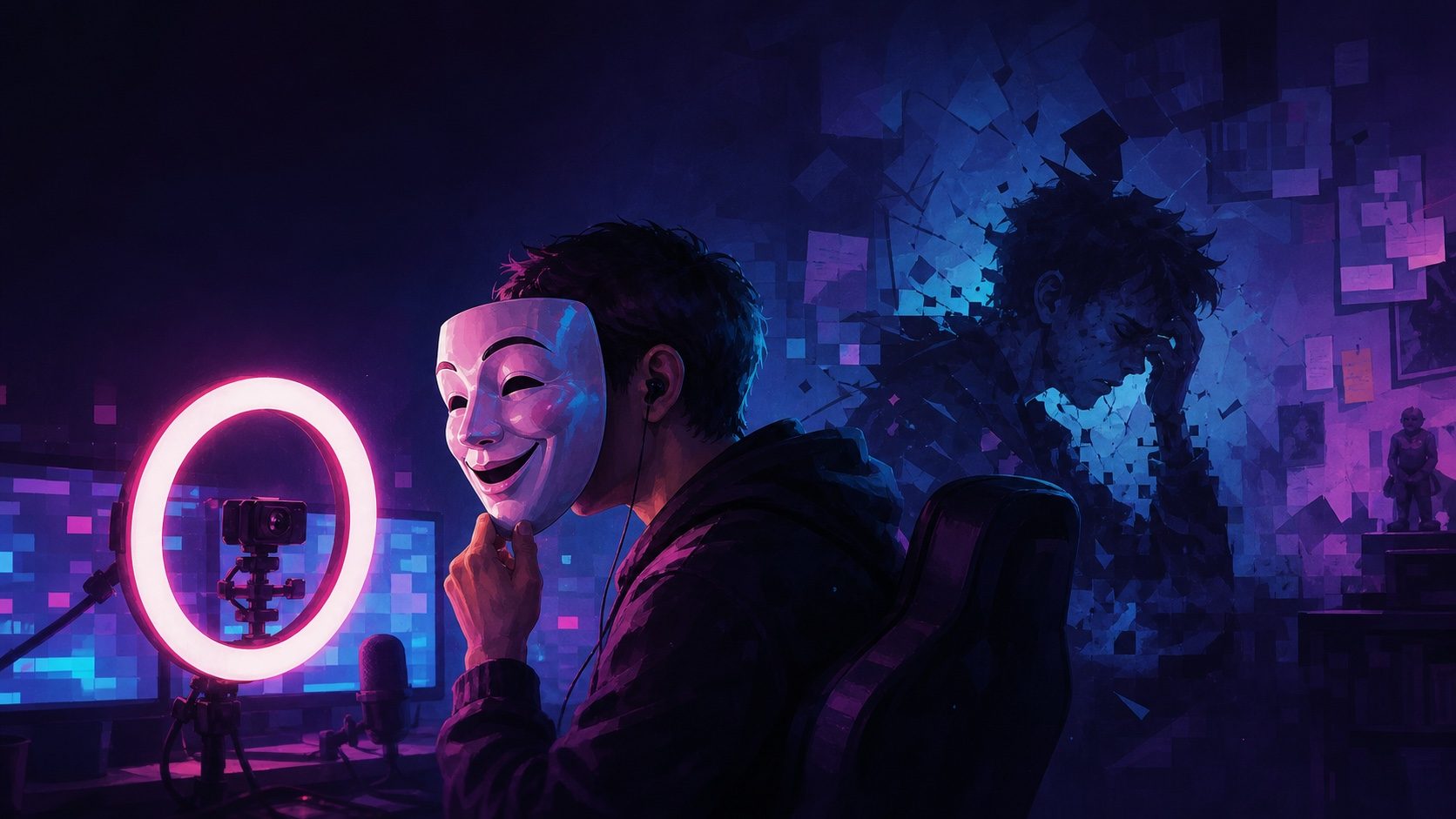
There's a curious moment in every stream: the second the camera turns on. The voice shifts register, the energy climbs, the person "steps into character." It isn't fakeness, it's something else, more interesting and more human than that. The streamer isn't lying; they're putting on a persona. And psychoanalysis has plenty to say about who this figure is, the one who shows up whenever we're being seen.
The ego-ideal: who I'd like to be for the Other
Psychoanalysis draws a line between who we are and who we'd like to be in other people's eyes. That second image, polished, funny at exactly the right moment, always with the perfect reaction, is what comes close to the ego-ideal: an idealized version of oneself, built for the gaze of the other. The streamer's persona is that taken pro: an image calibrated to please, to engage, to be loved by the audience. Everyone has an ego-ideal; the streamer has simply turned theirs into a product and switches it on with a click.
Winnicott's false self
Winnicott described something that lights up the hard side of all this: the false self. It's the shell we develop to meet what others expect of us, competent, agreeable, functional, while the true self, with its exhaustions and its less marketable parts, stays protected back behind it. A little false self is healthy: it's manners, it's social adaptation. The trouble starts when the persona has to be on air all the time, when the audience demands the same energy every single day, and the real self slowly runs out of room to simply exist, tired, unfunny, human.
The cost of being loved as an image
Here's the part almost nobody sees during a stream. Being loved for the persona is, deep down, a fairly lonely thing, because it isn't you being loved, it's the image. The more the audience adores the character, the more the streamer can feel that the true self has to stay hidden, or risk disappointing everyone. That's the paradox of the ego-ideal: the more perfect it gets, the further it drifts from who you actually are, and the scarier it becomes to show the gap. The burnout of so many creators isn't just overwork; it's the weight of holding a persona upright with no breaks.
Neither villain nor victim, human
None of this condemns streamers, quite the opposite. The persona is a legitimate creation, sometimes a work of art. The point is to remember, the viewers included, that behind the charismatic avatar there's a person who also has bad days and the right not to be "content" every waking hour. And for those who create: maybe the most radical gesture is to let the true self show through a little, every now and then. Curiously, it's almost always that moment, the human streamer, stripped of the persona's armor, that the audience remembers most.
Enjoy this kind of read, psychoanalysis mixed with games? Over on my Mercado Livre profile I leave picks of games worth analyzing. 😉
My picks (Mercado Livre) Affiliate links (Mercado Livre). This site may earn a commission on qualifying purchases, at no extra cost to you.Related
The Plucky Squire: what if your life were written by someone else? GTA 6 made $1 billion before it existed: FOMOReferences
Winnicott, D. W., the false and the true self (1960). · Freud, S., the ego-ideal and the ideal ego (On Narcissism, 1914; Group Psychology and the Analysis of the Ego, 1921).
Comments
What did you think of this piece? Agree, disagree, have another reading of the game? Drop a comment below, I read them all and love keeping the conversation going. 👇