
The Plucky Squire: what if your life were a story written by someone else?
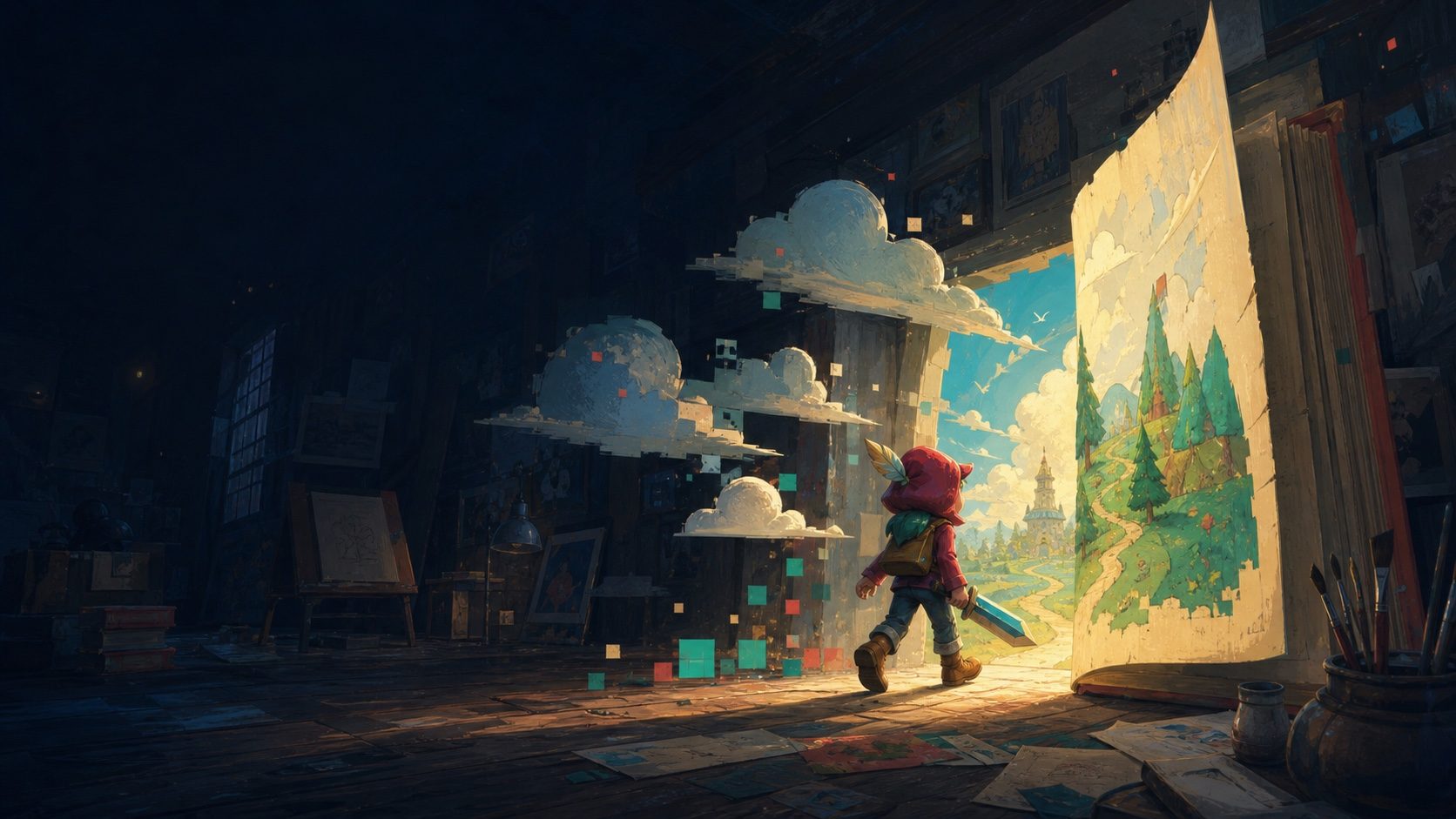
Everyone has dreamed of stepping into a book. Few stop to think about the opposite: what if one day you found out that your entire life was just a story written by someone else? That's the question The Plucky Squire turns into a game, and it's why it's far more than one of the most beautiful indies of recent years. Behind the children's-book look, there's a precise metaphor about identity, growing up, and the moment when fantasy can no longer contain reality.
A perfect world, and why that should make you suspicious
At first, Dot lives in a flawless world. He's the hero, the villain is clear-cut, the adventure is neatly arranged, and everything is heading, naturally, toward a happy ending. Everything has its place; there's no doubt, ambiguity or uncertainty.
This kind of universe is psychologically recognizable: it's a closed system, a reality in which nothing needs to be questioned because everything comes predefined. It's reassuring, and that's exactly why it's suspect. Flawless worlds don't exist outside of books. Dot's initial perfection isn't just set dressing; it's the portrait of a fantasy that hasn't been punctured yet.
The moment the page tears
Then the essential thing happens: Dot is ripped out of the story. Literally thrown off the page. And here the game makes its smartest move, it turns a mechanic into a psychological experience. You stop being inside the narrative and start seeing it from outside. What looked like a complete universe reveals itself to be just one layer of reality.
Notice that the passage from the paper world (2D) to the "real" world (3D) isn't an aesthetic trick. It's a symbolic rupture: the instant when fantasy stops being total. And anyone lives this at some point, it's when we discover that the world isn't as tidy as it seemed, that there isn't always a clear script or a narrator guaranteeing everything will turn out fine.
Discovering you're a character
Dot isn't just a character. He discovers that he is one. And that awareness changes everything, for him and for whoever's playing.
In the clinic, this is less exotic than it sounds. Plenty of people arrive at some point in life with the sense of following a script they never chose: family expectations, an inherited career path, social roles that got put on without anyone stopping to ask whether they made sense. Psychoanalysis starts from a similar idea, we're born into a story that was already being told before us, made of other people's language and desire. When Dot realizes that the plot itself can be altered, the game elegantly formulates the most human question there is: who is writing my life, me, other people, chance?
It's no accident that the villain doesn't just want to defeat the hero. He wants to rewrite the story, to take control of the narrative. The conflict looks external, but it stages something internal: the fight over the authorship of one's own existence.
Rewriting the plot: the mechanic as re-signification
Then comes the most beautiful step. You don't watch this transformation, you take part in it. You change words, rearrange sentences, alter the scenery by editing the text directly. What was written stops being fixed and becomes something you can manipulate.
This is almost a playful staging of what we call re-signification. The way you tell your own story directly shapes how you live it. The facts don't change, the loss still happened, but their meaning does. And when the meaning changes, everything changes. Dot doesn't grow only by gaining skill or power; he grows by gaining the awareness that the world isn't given, it's built, and that he can intervene in that building.
Playing after the end of innocence
What's left to explain is why the game chooses the aesthetic of a children's book, colorful, light, enchanting. It's not just visual charm. It's the heart of the experience, because at bottom this is a story about the end of innocence: that moment when we realize the world isn't simple, that it isn't just good versus evil, that not everything resolves cleanly.
Here's where Donald Winnicott helps. For him, playing isn't a pastime: it happens in a potential space, a third area between inner fantasy and outer reality, where the child experiments, creates and rehearses the world in safety (Playing and Reality, 1971; the formulation of transitional objects and phenomena is from 1953). Dot's book is that space. Being thrown out of it is the end of fantasy's omnipotence, but Winnicott would say that growing up isn't abandoning that space, it's learning to inhabit it differently.
And that's exactly what the game proposes. It doesn't ask you to drop your imagination, nor claim that the real world is truer. It suggests that fantasy go on existing, no longer as a refuge where you hide, but as a tool you carry to make meaning. In the end, maybe the most important message is this: you may not have written the beginning of your story, but at some point you start taking part in the writing. And that changes everything.

Interested in The Plucky Squire? Grab it here and help the channel grow. 🎮
See The Plucky Squire Affiliate links. As an Amazon Associate, this site earns from qualifying purchases, at no extra cost to you.References
Winnicott, D. W. Transitional Objects and Transitional Phenomena (1953). · Winnicott, D. W. Playing and Reality (1971).
Comments
What did you think of this piece? Agree, disagree, have another reading of the game? Drop a comment below, I read them all and love keeping the conversation going. 👇