The Last of Us Part II: why the story falls apart from within
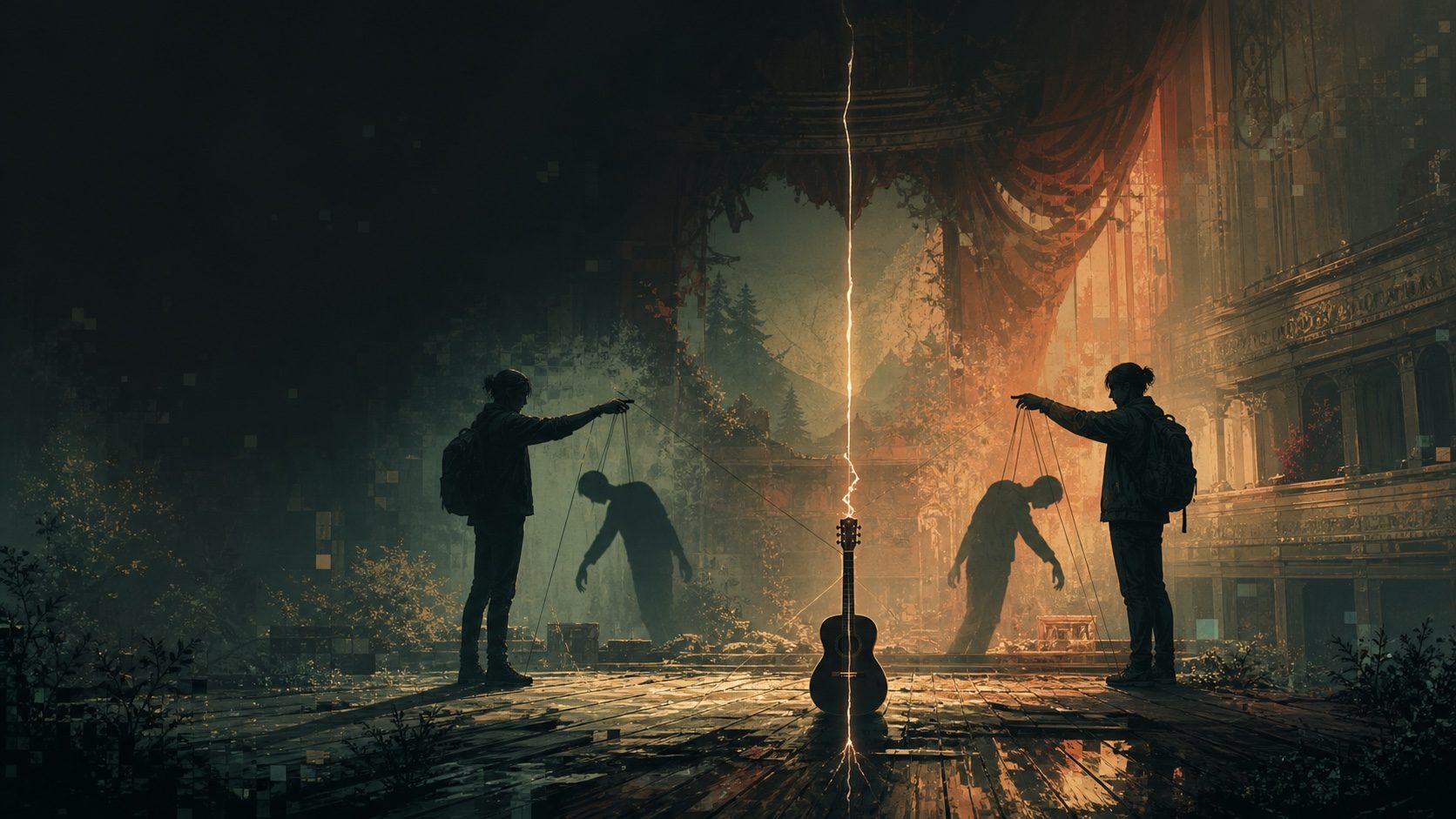
If you loved The Last of Us Part II, this piece is going to annoy you. If you hated it, you might discover you hated it for the wrong reasons. The thesis is simple and uncomfortable: the second game isn't just darker than the first, it retroactively sabotages the meaning of what made the first one unforgettable. And it does so not through narrative daring, but through psychological incoherence.
The first game was never about violence, it was about a mourning
Violence runs all through the first The Last of Us: brutal deaths, cannibalism, torture, despair. But all of it is a backdrop for something else. At the center is an emotionally dead man slowly relearning how to attach to the world.
And "emotionally dead" isn't a figure of speech. Sarah's death destroys Joel's capacity to invest affection. What's left is functioning without a future, without hope, without any working-through of the mourning, a picture Freud described with precision in Mourning and Melancholia: where mourning is the slow work of taking leave of what was lost, melancholia is the loss that goes unworked and hardens the subject from within (Freud, Mourning and Melancholia, 1917 [1915]). Joel is a man organized by trauma.
That's where Ellie comes in, and the beautiful part is that the bond doesn't form quickly or sentimentally. It's built with resistance, irritation, denial, small human moments. Joel doesn't want to love Ellie: to love is to risk losing again. When he finally does love, the game doesn't turn it into a moral virtue. Joel stays deeply flawed, and deeply human.
Joel's death: shock without working-through
The problem with the second game is not that it kills Joel. Great stories kill off important characters all the time. The problem is how.
Joel doesn't die at the climax of his own arc, nor protecting Ellie, nor reconciling his inner conflicts. He dies as a shock device, and, worse, in a way that's incoherent with who he was. The Joel of the first game would never have walked like that into an unfamiliar place, dropping his guard in front of armed strangers and handing over his own name.
The most common defense is that "he softened up in Jackson." It makes sense that he'd be less hardened, but structural trauma doesn't just evaporate like that. Freud showed that what isn't worked through tends to repeat, and that overcoming it demands psychic labor, working-through (Remembering, Repeating and Working-Through, 1914). The script skips exactly that process: it hands us a vulnerable Joel at the precise moment it needs to kill him. It's the first appearance of a vice that infects the whole game, the story steering the characters, instead of the other way around.
Abby and the flashback almost nobody talks about
The game clearly wants you to come around to Abby. But rather than build that organically, it takes shortcuts: she plays with the dog, protects a child, saves the vulnerable. It's a sequence engineered to make you accept her.
There is, however, one scene that changes how you read the character, and almost nobody points to it. In a flashback, Abby overhears, hidden, a conversation between her father, Jerry, and Marlene about the procedure on Ellie. Marlene asks the question that's worth its weight in gold: and if it were Abby who had to die to produce the cure, would you allow it? Jerry freezes. In the silence, he admits he wouldn't apply to his own daughter the decision he's about to impose on Ellie.
And what does Abby do? Instead of balking at the asymmetry, "why is it off the table for me but fine for her?", she says exactly what her father needed to hear to carry on without guilt: that, in Ellie's place, she would authorize it. It's a moral alibi delivered at the precise moment. Clinically, that doesn't reveal filial devotion; it reveals the capacity to articulate an argument for the death of a child she has never met, right when that argument is useful. And all of it before any trauma, mourning or revenge.
The consent the game pretends not to see
There's a detail that dismantles any defense of what the Fireflies were about to do. Jerry is presented as chief surgeon, but the first game's material indicates his training is in biology, he became a surgeon because the world ended. And the hospital records make clear that previous attempts at the same procedure failed, with every patient dead.
So the scene isn't a qualified researcher making a hard decision for the greater good. It's an improvised biologist-turned-surgeon, with a record of failures, about to open the skull of a sedated minor, without consent, betting that this time it'll work. Free and informed consent isn't bureaucracy: it's a basic ethical principle of any research with human beings, decision-making capacity preserved, the right to refuse without penalty, extra protection for vulnerable subjects, a category a minor falls into automatically.
Ellie reached the hospital conscious: walking, talking, alive. They only had to sit her down with Joel, the adult she trusted, and the doctor, explain that the procedure was fatal, and let her decide. They didn't. They sedated her first, took Joel out of the room, treated it as a technical decision. The most economical reading is a harsh one: they didn't ask because they knew the real risk of a "no." They preferred the hypothetical line from a teenager behind a door to the concrete answer of the person who would be opened up on the table.
The "selfish Joel" reading is false, not incomplete, false
The version the internet and the second game itself push is that Joel massacred the Fireflies out of fatherly selfishness: he couldn't bear to lose another daughter and doomed humanity to preserve an emotional possession, almost a denial of Sarah's mourning projected onto Ellie. It's this reading that props up the moral equivalence the game spends forty hours building.
Except it requires erasing half of what's on the screen. What Joel sees at the hospital isn't a team carrying out a collective salvation. It's a group of armed adults, in an improvised hospital, ready to open up a sedated minor without asking, without a goodbye, with orders to execute him if he resists, backed by the unproven promise of an improvised surgeon with a record of failure.
And the bond with Ellie isn't what the selfish reading suggests, either. It's not transference: Ellie isn't an object standing in for Sarah. She's another person, real, whom he learned to love over months, through friction and discovery. When he comes in shooting, it's not a father losing it and depriving the world of a cure, it's the man who spent years dead inside becoming whole again. His sense of justice returns together with his capacity to love. That's why the scene is one of the most powerful video games have ever produced: saving Ellie and stopping the barbarism are the same gesture.
That is precisely what the second game destroys. It doesn't just kill Joel, it rewrites the meaning of the massacre. It takes the one moment when Joel becomes whole again and treats it as the original sin that has to be paid for. The man who was reborn because he stopped a cult is killed for having stopped it. That isn't just weak writing; it's sabotage of the meaning of the first game.
Trauma doesn't work like that
Once you see this design, the incoherences of the second half stop being isolated flaws. To draw the two sides morally even at any cost, the game needs its characters to act in psychologically implausible ways.
Ellie is the clearest case. The game talks about trauma the whole time, but severe trauma doesn't look like this. In the clinic, what you see is paralysis, withdrawal, looping repetition, dissociative crises in the middle of trivial tasks, not the execution of a transcontinental plan with tactical precision. Ellie watches Joel be killed, tortures, kills people she knows, kills a pregnant woman, destroys her own emotional life and keeps advancing almost linearly toward the next event. Moments that ought to produce collapse, like discovering Mel's pregnancy, become nothing but fuel for the plot to continue. It's the opposite of the compulsion to repeat Freud described in Beyond the Pleasure Principle (1920): the trauma that repeats and paralyzes, not one that drives you linearly forward.
Tommy's turn is another visible seam: the man who, at the start, tries to stop Ellie from going after Abby reappears at the farm pushing her toward revenge, with no development to explain the reversal. And the final forgiveness, after Ellie has left a trail of corpses, works nothing through: it's the narrative cowardice of someone who wants the moral credit of forgiveness without paying the dramatic cost, neither consummating the revenge nor giving it up before the massacre. There remains, too, an asymmetry the game never faces: Ellie kills Mel and the baby, yet is treated as the one who needs to break the cycle; Abby, who engineered Ellie's death while still a teenager and tortured Joel choosing the instrument and the timing, is treated as a mourner. The two do the same thing, and the script decides, from outside, who deserves redemption.
Tragedy isn't the same thing as nihilism
That's why so many people finished the game exhausted rather than moved. There's a vast difference between tragedy and emotional nihilism. The first game is tragic, but it still believes the human bond can rescue someone from collapse, Joel comes back to love and acts, in the end, as a whole man. The second operates on the opposite premise: nobody truly rebuilds. Joel finds peace and is killed; Ellie builds a life with Dina and abandons it; Abby becomes a surrogate mother to Lev and loses almost everything. Every attempt at emotional reconstruction is cut short or revealed as an illusion. It's as if the game had to prove that the hope planted in the first one was naive and disposable.
Somewhere between one game and the next, someone lost touch with what made the first The Last of Us unforgettable: the profoundly human experience of following someone emotionally destroyed as he slowly relearns how to love.

Interested in The Last of Us Part II? Grab it here and help the channel grow. 🎮
The Last of Us Part II The Last of Us Part I Affiliate links. As an Amazon Associate, this site earns from qualifying purchases, at no extra cost to you.Related
The Plucky Squire: growing up means taking authorship of your own story Concept: mourning vs. melancholia in gamesReferences
Freud, S. Mourning and Melancholia (1917 [1915]). · Freud, S. Remembering, Repeating and Working-Through (1914). · Freud, S. Beyond the Pleasure Principle (1920).
Comments
What did you think of this piece? Agree, disagree, have another reading of the game? Drop a comment below, I read them all and love keeping the conversation going. 👇