BioShock: "Would you kindly" and the illusion of free will
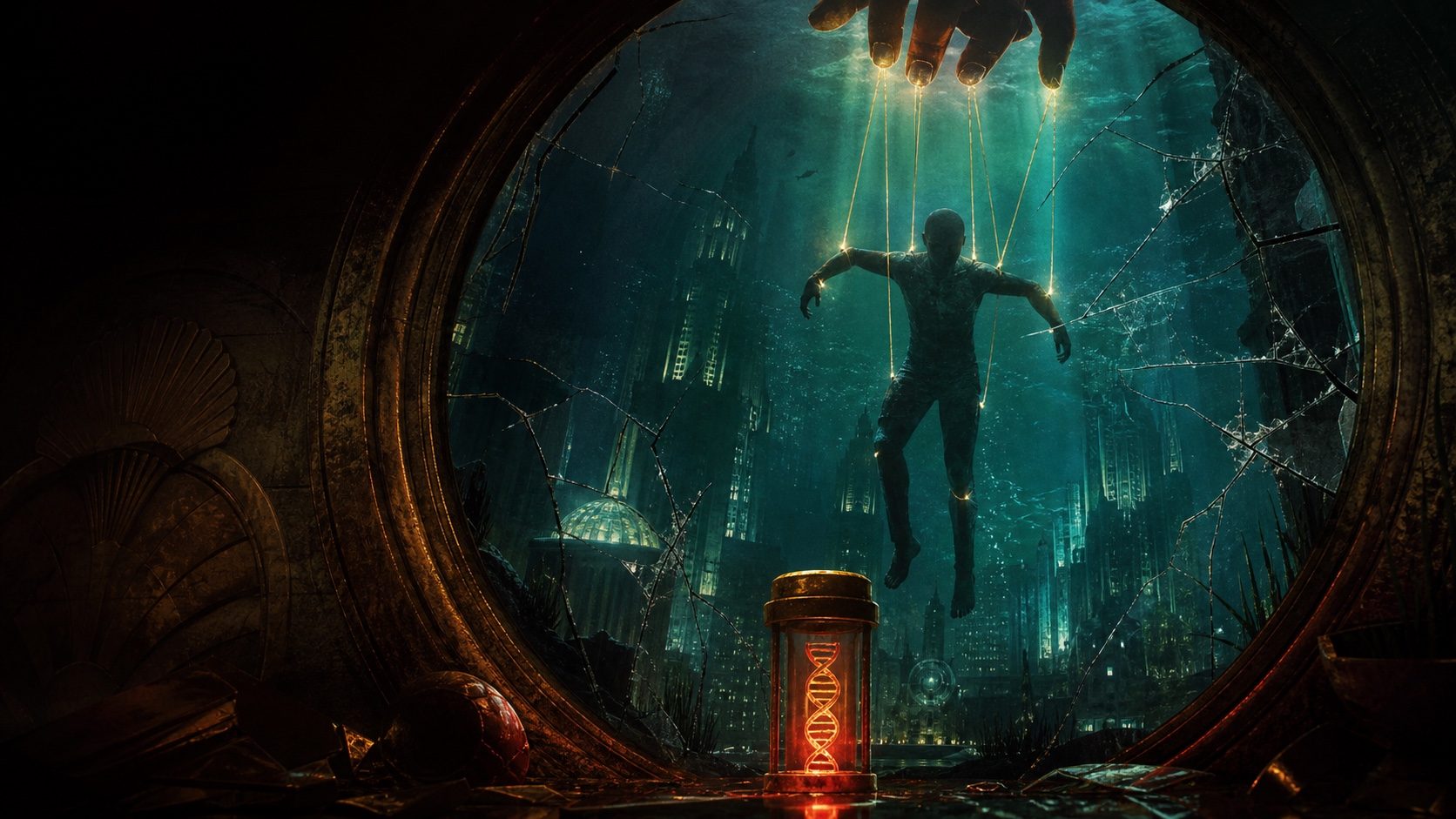
There's a line in BioShock that, the moment it lands, makes you drop the controller and stare into space: "Would you kindly." Throughout the entire game, this seemingly polite phrase precedes every order you receive. And about halfway through, the game reveals the truth: every time you "chose" to act, you were in fact obeying. Not Jack, the character. You. BioShock uses the video game to ask the very question psychoanalysis has been asking for over a century: do you actually choose, or are you just carrying out a command you never even knew existed?
Rapture: the utopia of the sovereign individual
The underwater city of Rapture was built by Andrew Ryan as the dream of the man who owes nothing to anyone, the self-sufficient individual, absolute master of himself, free of God, the State, and collective morality. It's the narcissistic fantasy turned into architecture: an entire world raised to prove that "I am enough unto myself." And, like every fantasy of omnipotence, it collapses. Rapture rots into war, addiction, and madness, because the absolutely sovereign individual is an illusion. No one is the complete origin of himself. Every one of us is traversed by the desire and the speech of others long before we decide anything at all.
The hidden command
And here's the masterstroke. While you think you're making heroic decisions, every one of them was triggered by "would you kindly." The game literalizes a central idea of Lacan's: the unconscious is the discourse of the Other. In other words, what we experience as "my will" is, in large part, commanded by signifiers that came from outside, words, orders, other people's desires that inhabit us without our noticing. You played for hours convinced you were acting on your own account. The twist doesn't expose Jack's servitude; it exposes yours. And that's why it stings: for an instant, you feel in your own skin what it means to be spoken by something you don't control.
"A man chooses, a slave obeys"
In the confrontation with Ryan, the phrase turns to a blade: "a man chooses, a slave obeys." And then Ryan hands you the club and orders you, using the trigger, to kill him. You kill him. There's no choice; there's execution. And there's a further layer: Ryan is Jack's biological father. So what happens there is, once again, a parricide, but a commanded one, staged to prove a thesis about free will. It's the same Oedipal knot we unpacked in the analysis of God of War: killing the father. Except here the son is an instrument, and the father chooses his own death to drive his point home. The tragedy isn't being forced to kill; it's discovering that maybe there never was a "you" free to refuse, an Oedipus without a subject. It's the exact instant BioShock stages what Lacan calls the barred subject ($): the self that discovers it is divided, traversed, and spoken by a desire that came from elsewhere.
ADAM: the body remade by desire
And there's the fuel behind it all: ADAM, the substance that grants superpowers and destroys whoever uses it. The splicers, once citizens, became disfigured addicts, willing to kill for one more dose. It's the rawest portrait of a drive that knows no limit: the jouissance that promises potency and delivers ruin. Rapture promised absolute freedom and produced the most basic slavery of all, the body held hostage by its own desire. The city of total autonomy became an anthill of people commanded by lack.
The choice that's left
Final irony: right after showing you that you never chose anything, the game offers you a real choice, save or "harvest" the Little Sisters, the girls turned into ADAM factories. It's small, it's moral, and maybe that's exactly why it matters. If grand freedom is an illusion, what remains of the human is the minimal ethical gesture: sparing the one you could exploit. It isn't Ryan's omnipotence. It's something more modest and more true, responsibility for how you treat the other, even inside a world that programmed you.
Why the twist still gives you chills
BioShock has aged so well because its blow isn't about Jack, it's about you, controller in hand, believing you decide. It uses the one language in which this could truly be felt, not just explained: interactivity. For a moment, the game makes you live psychoanalysis's most uncomfortable discovery, that the self is not master in its own house. And then it hands back the one freedom that might be real: to choose, now that you know, what to do with it.

Interested in BioShock? Grab it here and help the channel grow. 🎮
See BioShock: The Collection Affiliate links. As an Amazon Associate, this site earns from qualifying purchases, at no extra cost to you.Related
Kratos killed his own gods, and his own father GTA 6 made $1 billion before it existed. That's called FOMOReferences
Lacan, J., "the unconscious is the discourse of the Other," the subject determined by the signifier, and the barred subject ($). · Freud, S., the Oedipus complex (parricide).
Comments
What did you think of this piece? Agree, disagree, have another reading of the game? Drop a comment below, I read them all and love keeping the conversation going. 👇