
Kratos killed his own gods, and his own father
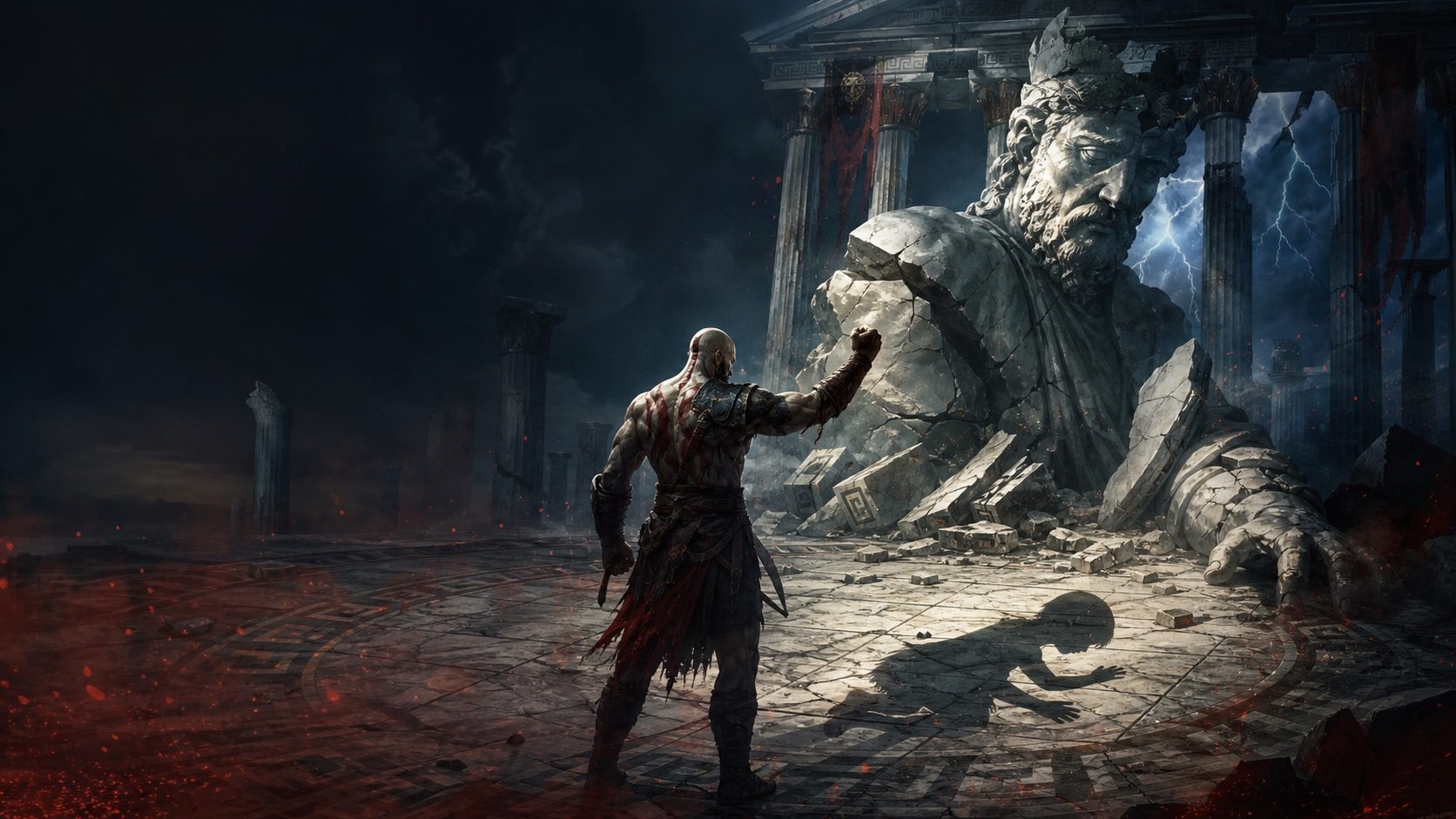
There's a detail in God of War that slips by unnoticed amid all the blood: Kratos's Greek saga isn't just inspired by mythology, it's a Greek tragedy in the technical sense of the term. And the Ghost of Sparta, that tank of muscle and hatred, is a textbook psychoanalytic case. He kills the gods, one by one. And the last one he kills is the father. Hold on, because this runs deeper than it looks.
Hubris and nemesis: the machinery of tragedy
Greek tragedy runs on a fixed mechanism. The hero commits hubris, the arrogance of one who defies the divine order, and nemesis, the punishment, comes inevitably. Oedipus tries to flee the oracle and, in fleeing, fulfills the prophecy exactly. It's the structure of the whole of God of War: every time Kratos tries to be rid of his pain by destroying whoever caused it, he produces more pain. He wants peace and sows ruin. Aristotle would remind us that tragedy serves to bring about a catharsis, but in the spectator, not in the hero: the discharge that reorganizes is the one we feel watching him. Kratos never works anything through; he only discharges. And discharging doesn't heal.
Oedipus with an axe
Freud named the Oedipus complex precisely after Sophocles's play: the infantile, repressed wish tied to killing the father and taking his place. In most people this stays on the plane of the unconscious, worked through over the course of a life. Kratos doesn't work it through: he executes it. He discovers that Zeus is his father and drives the blade in. It's not metaphor, not a dream, it's parricide staged literally on the screen, with no symbolic filter. God of War takes the most repressed conflict of the human psyche and turns it into a boss fight. That's why the saga unsettles us so much: it touches, undisguised, on what we buried.
Narcissistic rage
But why all the rage? Here narcissism comes in, and not in the sense of vanity. Freud described the investment in one's own ego and the wound to self-love (On Narcissism: An Introduction, 1914); and it was Heinz Kohut who named what the wound produces: narcissistic rage, that destructive fury into which an injured ego converts the pain it can't bear (Thoughts on Narcissism and Narcissistic Rage, 1972). Kratos is a walking wound: deceived, humiliated, guilty of the death of his own family. An ego that injured cannot feel the pain as mourning, it converts it into fury. That's what narcissistic rage is: turning the unbearable "I hate myself for what I did" into the far more tolerable "I'm going to destroy you." That's why Kratos doesn't grieve his family; he sets Olympus ablaze. The destruction on the outside is a defense against the implosion within.
The ashes that won't leave the skin
And there's the most psychoanalytic detail of all: Kratos's white skin is the ashes of his dead wife and daughter, fused to him forever by a curse. Think about what that stages. The guilt he can't work through doesn't vanish, it stays embedded in the body, visible, permanent. It's the repressed that won't go down: it becomes a symptom in the flesh itself. Kratos literally carries the proof of what he did, and no revenge washes it off. The more he kills to be rid of the guilt, the whiter his skin becomes. Revenge is the failed attempt to scrub off the ashes with blood.
The way out was to become a father
And here is the franchise's brilliant turn. When Kratos reemerges in the Norse era, older and worn, he's no longer hunting gods, he's raising a son. For the first time, instead of killing the father, he is the father. And his task stops being to destroy and becomes not to repeat: not to pass on to Atreus the same fury he inherited. It's the possibility Greek tragedy never gave Oedipus, the chance to break the cycle. Kratos spends the entire saga learning the hardest thing for a wounded narcissist: to contain the rage so the son doesn't turn into another Kratos. The revenge is over. The work begins.

Interested in God of War? Grab it here and help the channel grow. 🎮
God of War III God of War (2018) God of War RagnarökFor collectors: the DualSense controller God of War (20th Anniversary Edition).
Affiliate links. As an Amazon Associate, this site earns from qualifying purchases, at no extra cost to you.Related
Red Dead Redemption 2: Arthur finds out he's going to die, and starts to live Death Stranding: a world without the Name-of-the-FatherReferences
Freud, S., the Oedipus complex and On Narcissism: An Introduction (1914). · Kohut, H. Thoughts on Narcissism and Narcissistic Rage (1972), narcissistic rage. · The structure of Greek tragedy (hubris, nemesis, catharsis), after Aristotle, Poetics.
Comments
What did you think of this piece? Agree, disagree, have another reading of the game? Drop a comment below, I read them all and love keeping the conversation going. 👇