
The guilt of gaming as an adult: am I wasting my time?
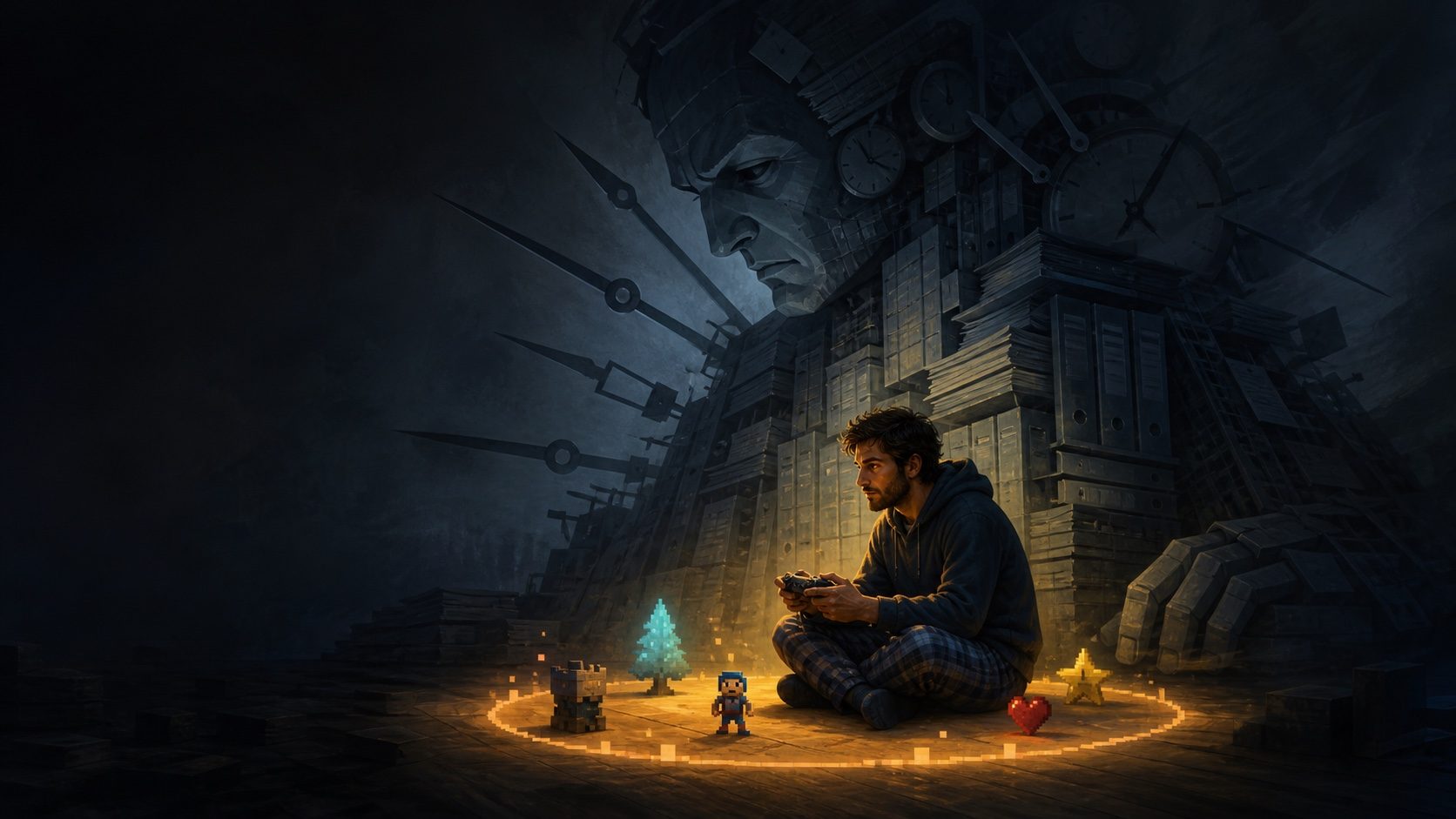
You finally sit down to play after a long day. Half an hour in, instead of relaxation, a small voice pipes up: "you had so much to do." The dishes, the email, that stalled project, the whole "you should be being productive." The fun sours. If that sounds familiar, you're not lazy or immature, you're listening to a voice that adult life installed in nearly all of us. And it's worth understanding whose voice that is.
The superego became a productivity manager
In Freudian theory, we carry an inner agency that judges and demands: the superego. It forms out of the demands we absorb as we grow up, and it goes on running by itself, even with no one watching. The trouble is that, in the culture we live in, this inner judge has been trained on one particular value: that time only counts if it's productive. Work, output, "making the most of" every hour. By that yardstick, leisure with no return becomes suspect, and gaming, which produces nothing tangible, becomes "wasted time." The guilt you feel isn't about the game. It's the productivist superego charging a toll on any pleasure that doesn't look useful.
Why it stung less when we were kids
Notice that, as a child, you played with no guilt at all. Playing was your job, no one expected "productivity" from you. As we grow up, we inherit a silent equation: a real adult produces; playing is for people with no responsibilities. That equation is cultural, not a truth. But it sticks so deep that we start policing ourselves, turning a legitimate rest into a small moral failing. The adult guilt of gaming is, deep down, the guilt of being a child in the body of someone who "should" be being useful.
Winnicott: playing is not the opposite of serious
Here comes one of the most liberating ideas in psychoanalysis. For Donald Winnicott, playing is neither a pastime nor a regression: it's a vital function of the mind, the space where creativity, rest and the very sense of being alive take place (Playing and Reality, 1971). Winnicott went so far as to say that it's in playing that a person is most fully themselves. In other words: setting aside time to play isn't fleeing adult life, it's caring for a part of the mind that too much productivity smothers. The game doesn't steal your time; it returns you to a place you come back from more whole.
Guilt as a symptom of a bigger problem
It's worth paying attention to one point: if every form of rest gives you guilt, not just gaming, but reading aimlessly, lying down doing nothing, watching a show, then maybe the issue isn't the video game, but a relationship with yourself that's too demanding. A superego that won't let you rest charges a steep price: chronic exhaustion, irritability, that feeling of never being enough. Recognizing that you have a right to idleness is often a bigger piece of psychic work than it seems, and one of the most important.
Gaming without apologizing
So the next time that voice shows up in the middle of a session, you can answer it knowing exactly what you're talking about: resting isn't waste, playing isn't a character flaw, and a mind that only produces and never plays isn't healthier, it's drier. The balanced adult isn't the one who abandoned playing; it's the one who learned to grant themselves permission for it. Gaming, with pleasure and without guilt, may be one of the most grown-up things you do.
Into this kind of read, psychoanalysis mixed with games? On my Mercado Livre profile I leave picks for games that are worth the analysis. 😉
My picks (Mercado Livre) Affiliate links (Mercado Livre). This site may earn a commission on qualifying purchases, at no extra cost to you.Related
Retro-game nostalgia: why the past is such a comfort Why do we need to platinum? The psychoanalysis of 100%References
Winnicott, D. W., Playing and Reality (1971): playing as a creative and vital experience. · Freud, S., the superego (The Ego and the Id, 1923).
Comments
What did you think of this piece? Agree, disagree, have another reading of the game? Drop a comment below, I read them all and love keeping the conversation going. 👇