Why we keep playing what stopped being fun
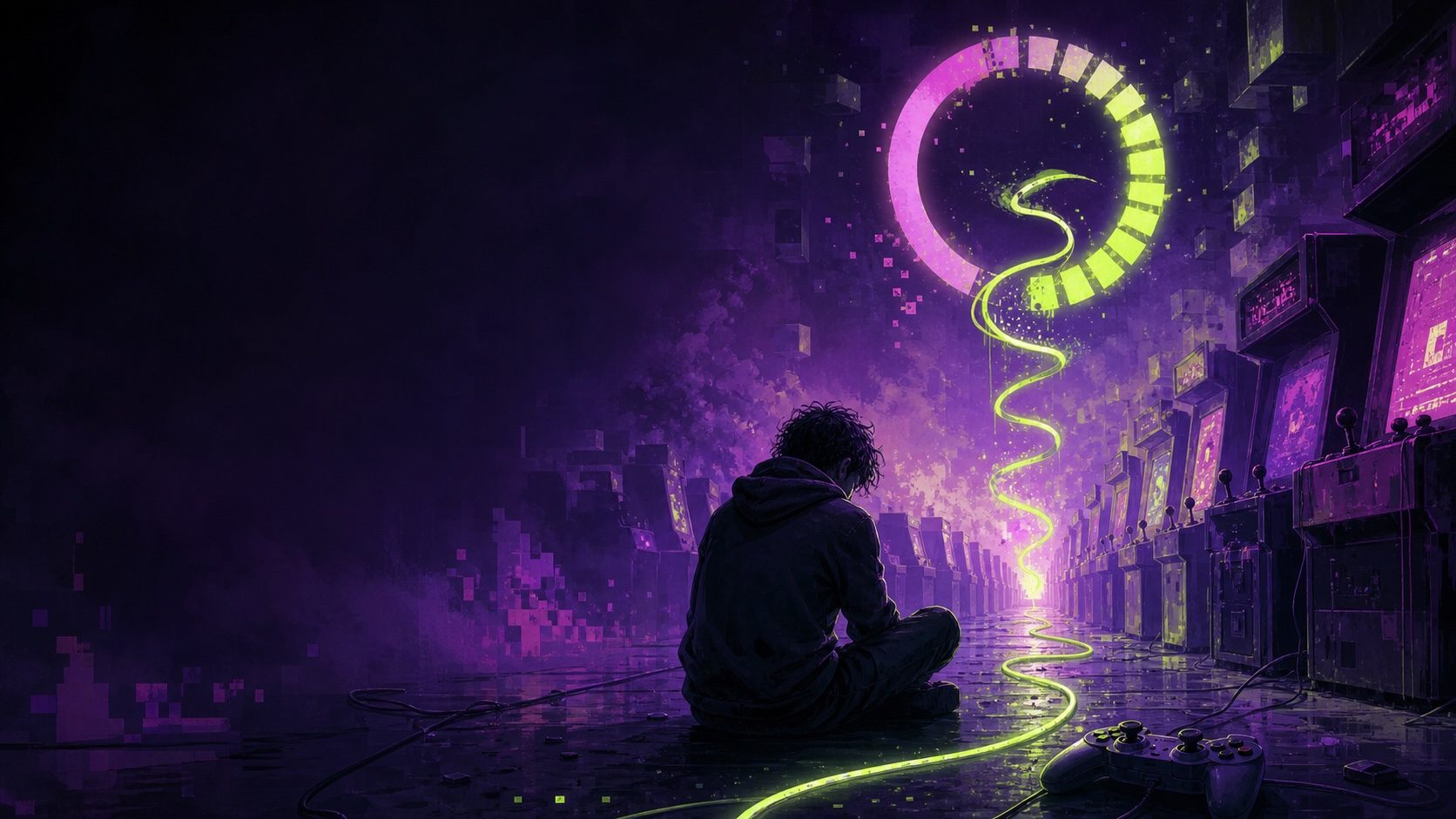
You know the scene: it's two in the morning, you're running the same daily quest for the hundredth time, farming an item you'll never use, and, be honest, you're not exactly having fun. And still, you don't put the controller down. If the game stopped giving pleasure, why do you keep going? Psychoanalysis has an uncomfortable, precise answer, and it has a name: jouissance.
Pleasure isn't the same as jouissance
We tend to think we're always chasing pleasure. But Freud, in Beyond the Pleasure Principle (1920), noticed something strange: people repeat, over and over, things that give no pleasure at all, sometimes even suffering. Lacan named that paradoxical satisfaction: jouissance, enjoyment beyond pleasure. Jouissance is a satisfaction that goes beyond pleasure, and, for that very reason, borders on displeasure. It's what insists, what repeats compulsively, even when it's no longer good. Pleasure is what satisfies and leaves you at peace; jouissance is what never quite satisfies and keeps you hooked.
The grind is a jouissance machine
Now look at the design of half of modern gaming. The infinite grind, the daily rewards, the loot box, the gacha, the bar that fills up slowly. None of it was made to give you pleasure and set you free, it was made to keep you in the loop. It's repetition for repetition's sake, the "just one more match" that turns into all-nighters. The industry doesn't sell fun; it sells jouissance, because jouissance is what doesn't end, and what doesn't end is what brings you back tomorrow. The games that grip us most aren't the most fun, they're the ones that best exploit this satisfaction that doesn't satisfy.
Why we repeat what hurts us
This doesn't only apply to games. It's the same machinery as the endless scroll on your phone, the mind that returns to the same bad thought, the habit we know is bad for us and won't drop. Jouissance lives in the symptom: there's a hidden satisfaction precisely in what we complain about. "I can't stand this game anymore" and going on playing isn't a contradiction, it's the very definition of jouissance. One part of you complains; another, quieter part is being satisfied underneath, in the act of repeating itself.
Naming jouissance already changes the game
And here's the useful part, no sermon. You don't need "willpower" to drop the grind. You just need to notice the difference: does this still give me pleasure, or has it become jouissance, repetition on autopilot? The instant you can name "ah, this isn't fun anymore, it's the machine holding me," something loosens. Jouissance loses part of its force when it stops being invisible. It isn't about quitting games, it's about getting back to choosing what actually still gives you pleasure.
Into this kind of reading, psychoanalysis mixed with games? Over on my Mercado Livre profile I leave picks for games worth analyzing. 😉
My picks (Mercado Livre) Affiliate link (Mercado Livre). This site may earn a commission on qualifying purchases, at no extra cost to you.Related
GTA 6 made $1 billion before it existed. That's called FOMO GTA doesn't sell crime: it sells a desire that never endsReferences
Freud, S. Beyond the Pleasure Principle (1920), the compulsion to repeat. · Lacan, J., the concept of jouissance, satisfaction beyond pleasure.
Comments
What did you think of this piece? Agree, disagree, have another reading of the game? Drop a comment below, I read them all and love keeping the conversation going. 👇