
GTA doesn't sell crime: it sells a desire that never ends

Millions of people who would never commit a crime open up GTA and, in the first five minutes, steal a car, run over a pedestrian and flee the police laughing. People who stop at red lights. And the one who explains why this feels so good isn't the game designer, it's psychoanalysis. GTA doesn't sell what you think it sells. Once you catch what it's really selling, you won't play it the same way again.
The city that says "do whatever you want"
Most games put you in a corridor: there's a path, you follow it, you kill the boss at the end. GTA does the opposite. It hands you a whole city and a single instruction: do whatever you want. That sounds like a technical game-design decision. It isn't, it's a psychological one. By removing the rails, GTA asks a question real life almost never lets you face head-on: what do you do when no one is holding you back, when there's no boss, no law, no consequence? The answer most people give in the first few minutes is chaos. Why? The answer has three layers.
First layer: playing (Winnicott)
Donald Winnicott, who was also a pediatrician, spent his life studying something everyone thinks is trivial: playing. And he realized that a child doesn't play just for fun, she plays to try out, in a protected space, everything she can't in real life: anger, aggression, destruction, power, fear. In play she can destroy the whole block city, and none of it destroys her back. Winnicott showed something even subtler: it's the object that survives our destruction that becomes real and usable for us (The Use of an Object, 1969). Playing is that safe testing ground for handling what is dangerous inside (Playing and Reality, 1971). GTA is exactly that, with a controller in hand. You go up to a five-star wanted level and no one really gets hurt, not the pedestrian, and not you, who go back to being a civilized person the second you switch off the console.
Second layer: the drive and the valve (Freud)
We're full of drive: the urge to transgress, to smash everything, to send order to hell. And, as Freud showed in Civilization and Its Discontents (1930), living in society costs dearly: to have traffic, law and coexistence, you hold those drives back all day, every day. That doesn't go away, it piles up. GTA is a release valve, what Freud would call substitute satisfaction: you discharge into a make-believe place an energy that's real. And pay attention, because this is the point people most often get wrong: psychoanalytically, the mechanism is the opposite of "the game makes you violent." It gives you a safe place for that energy to circulate with no consequence at all.
Third layer: omnipotence given back
GTA also gives you something you have nowhere else: absolute power. You don't really die, you respawn, you go immortal with a cheat code, and the city exists for you. Freud had an expression for this: the omnipotence of the infant who, at the start of life, believes the whole world exists to serve him, "His Majesty the Baby" (On Narcissism: An Introduction, 1914). Growing up is the painful process of losing that omnipotence, of discovering limits, consequence, death. GTA gives it back to you for a few hours. It's not about crime: it's about being, for a moment, the king of a world that obeys. A regression, but one in the service of pleasure, in a safe space, with a set time to end.
Why, even so, it never gives you peace
You want the better car; you get it. Then you want the house, the gun, the plane, 100% of the map. And when you've finished it all, that strange emptiness sets in: conquering everything left a hole instead of filling one. Lacan gave this a name: desire doesn't want the object, desire wants to keep desiring. The instant the car is yours, it loses its charm and desire has already jumped to the next thing. Something is always missing, the objet petit a, which doesn't exist to be reached, only to keep you moving. And Rockstar knows it: look at GTA Online, the infinite grind, the economy designed so you never have enough. GTA is built, system by system, as a desire machine.
The mirror
That's why the franchise is a satire of the American dream: it hands you the fantasy of rising up and then shows, without mercy, that no one gets there happy, the protagonists get everything and stay empty, paranoid, alone. GTA is honest about something the world out there is dishonest about: the object never fills you, it only shifts the hunger to the next thing. When you play GTA, you're not controlling a criminal on the screen. You're looking at yourself.
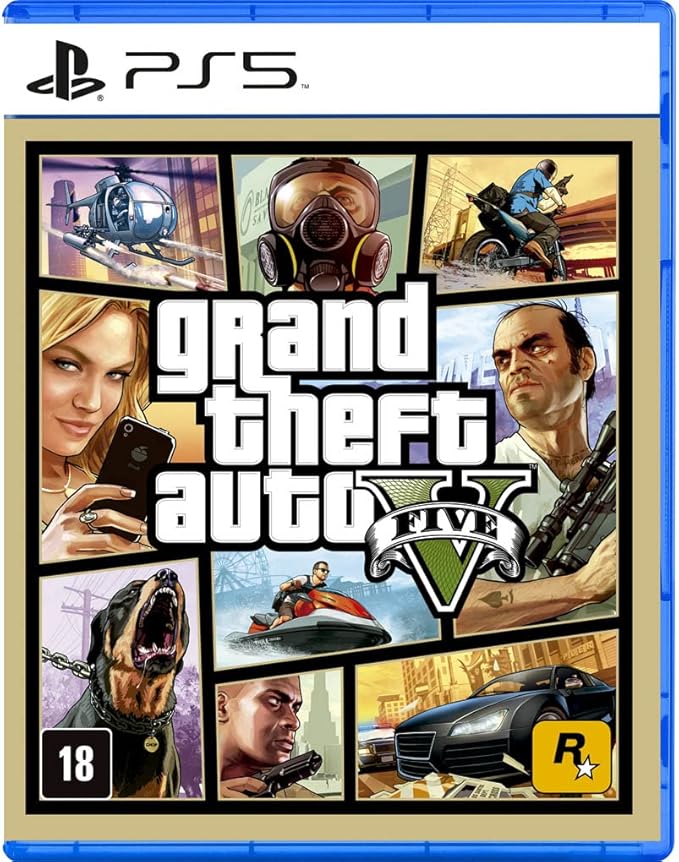
Interested in GTA V? Grab it here and help the channel grow. 🎮
See GTA V on Amazon Affiliate links. As an Amazon Associate, this site earns from qualifying purchases, at no extra cost to you.Related
Death Stranding: a world without the Name-of-the-Father The Last of Us Part II: why the story falls apartReferences
Winnicott, D. W. Playing and Reality (1971) and The Use of an Object (1969). · Freud, S. Civilization and Its Discontents (1930). · Freud, S. On Narcissism: An Introduction (1914). · Lacan, J., the concept of objet petit a.
Comments
What did you think of this piece? Agree, disagree, have another reading of the game? Drop a comment below, I read them all and love keeping the conversation going. 👇