
PlayStation is killing the disc, and the illusion that the game is yours
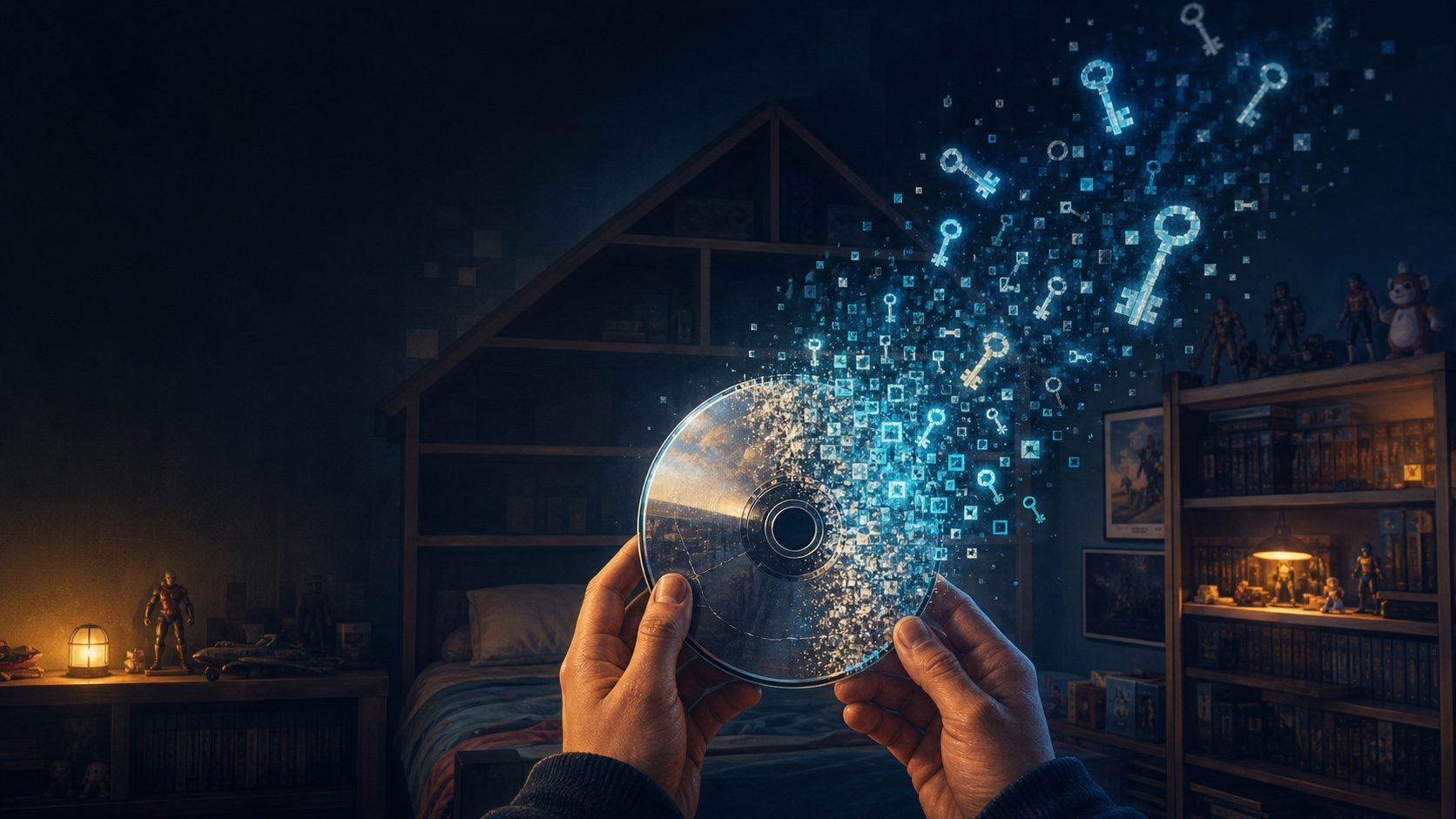
In July 2026, Sony announced it: starting in January 2028, new PlayStation games will no longer ship on disc. Digital only. The company pointed out that nearly 80% of PS4 and PS5 sales are already digital, so, on paper, it's just the logistics catching up to what people already do. But underneath the corporate press release there's a shift that touches something far deeper than plastic: our relationship with having.
The object you held in your hand
Think of the cartridge you blew into, the scratched CD that somehow still ran, the little case on the shelf. That was a real object, one you held, kept, lent out, collected. Winnicott called that first possession of a child's the transitional object, the blanket, the teddy bear, something that serves as an anchor, a bridge between the inner and outer worlds, something that is mine and that soothes me precisely because it really exists, outside of me. Physical game media always had a bit of that: an object that anchors the experience, that gives body and permanence to something that is, deep down, pure information. Having the game in your hand was having material proof that it was yours.
You were never the owner, you just hadn't noticed
And here's the uncomfortable truth that the end of the disc only makes visible: in digital, you never bought the game. You bought a license, the right to access, under conditions the company defines and can change. The game can be pulled from the store, the server can be switched off, the account can be suspended, and the thing you paid for simply evaporates. It isn't yours; it's on loan for an indefinite term. The disc had a beautiful flaw from the consumer's point of view: once it was in your hand, it was yours, period. No one erased it from your shelf remotely. What Sony is retiring isn't just the plastic, it's the last form of real ownership left in gaming.
The collector and the fear of lack
It's no accident that there's a legion of people who collect physical games with a passion (myself included, I've got my shelves). The collection isn't just nostalgia. Collecting is a way of dealing with lack: to gather objects, line them up, possess them, is to build with your own hands a sense of completeness and control in a world that grants neither. The shelf becomes an extension of the self, each box there tells who you are, what you've lived, what you love. There's even something of the fetish, in the best psychoanalytic sense of the word: the physical object carries a value that goes far beyond its function, because it symbolically plugs a hole. Take the object out of the world and you take from the collector one of the ways he had of feeling whole.
What is lost when the game becomes a ghost
Without the object, everything it made possible vanishes too: lending it to a friend, reselling it, buying it used, leaving it to a child. A physical collection crosses generations; a digital library dies with the account. Permanence vanishes, the certainty that the thing will keep existing even if the company loses interest. And a relationship with time vanishes: the disc aged alongside you, it bore the marks of use, it was a concrete piece of your history. Cloud access doesn't age, doesn't belong, doesn't stay. It only flows, always conditioned by a "for as long as it lasts".
The anxiety of depending on the Other
Deep down, the move from having to accessing is a move of power. When the object was yours, you were in charge of it. Now, between you and the thing you love there's always a company, an Other that holds the key, sets the rules, and can, at any moment, change the deal. It's an uncomfortable psychic position: never to have, always to depend on someone's permission to access what you love. We trade the security of owning for the convenience of accessing, and don't always notice how big the trade is. Less friction, yes. But also less ground under your feet.
Why it bothers us so much
When you feel a pang reading that the disc is going away, it isn't nostalgia for plastic. It's the realization that we're migrating from a world of ownership to a world of access, in which almost nothing is definitively ours: not the games, not the films, not the music. And having something that is truly yours, that no one can erase from a distance, is a more important psychic anchor than it seems. The end of physical media is convenient; it's the path of habit. But it also quietly closes the door to the last shelf where the game was, with no asterisk, yours.

Facing down the digital era? Grab yours here and help the channel grow. 🎮
Console PS5 Pro (Amazon) My picks (Mercado Livre) Affiliate links (Amazon and Mercado Livre). This site may earn a commission on qualifying purchases, at no extra cost to you.Related
GTA 6 made $1 billion before it existed. That's called FOMO GTA doesn't sell crime: it sells a desire that never endsReferences
Winnicott, D. W., the transitional object. · Lacan, J., the object in the field of the Other. · Sony announcement (PlayStation.Blog, Jul 1, 2026): end of physical disc production in January 2028.
Comments
What did you think of this piece? Agree, disagree, have another reading of the game? Drop a comment below, I read them all and love keeping the conversation going. 👇