
Warhammer 40,000: an empire that worships a dead father
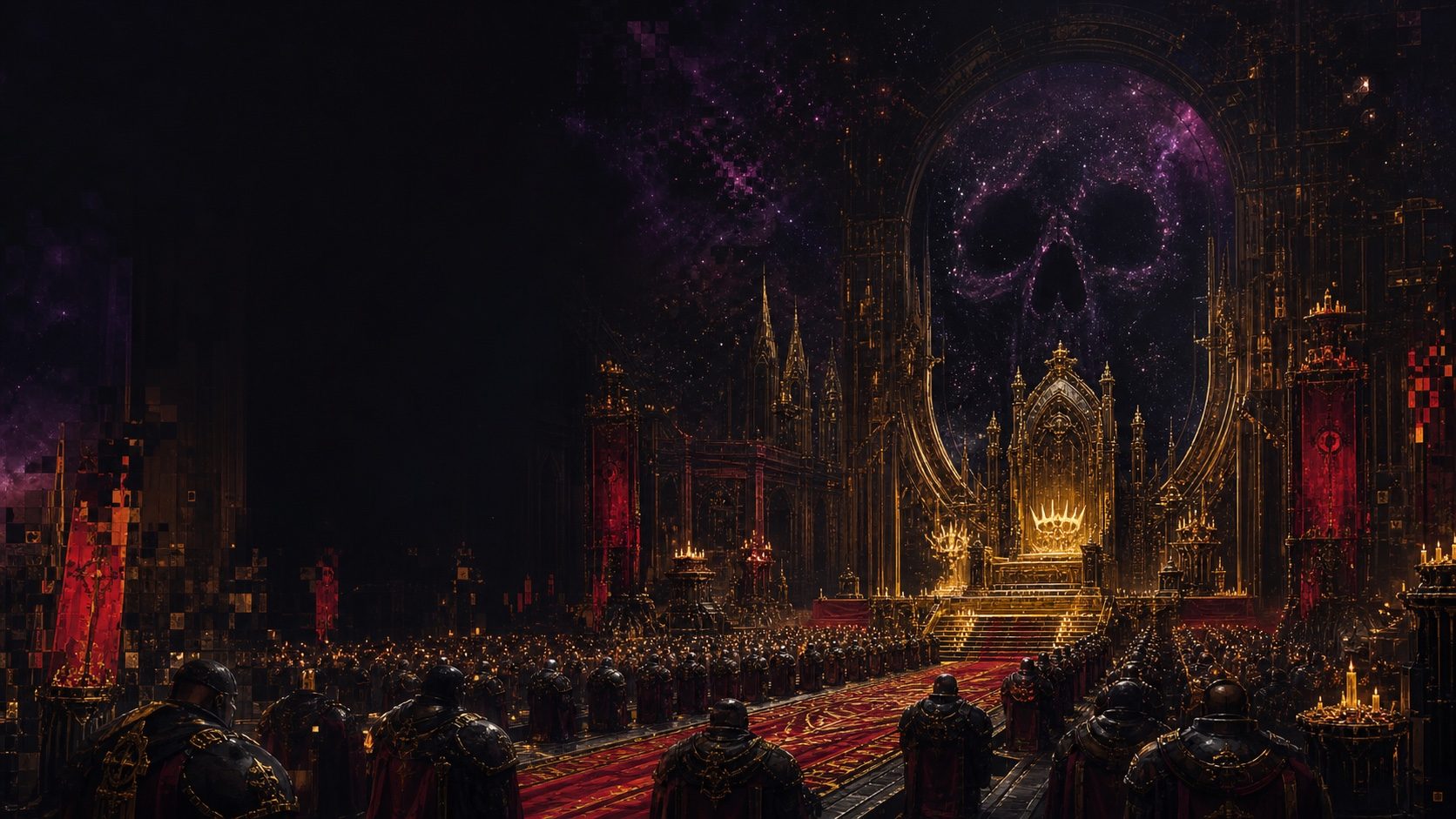
In the grim universe of Warhammer 40,000, humanity worships a living god: the Emperor. There's just one catch, he's dead. Or nearly. For ten thousand years he's been bound to the Golden Throne, a rotting body held suspended between life and death, unable to speak, yet venerated by a trillion faithful. And here's the truly disturbing part: it's precisely this corpse that holds the entire Imperium upright. It isn't a set piece. It's the secret psychoanalytic thesis of all of 40k.
The dead father commands more than the living one
In Totem and Taboo, Freud wrote about a founding paradox: the dead father becomes more powerful than he ever was in life. Once eliminated, he stops being a concrete obstacle and turns into law, symbol, absolute reference, an authority no one can challenge because he's no longer a person, he's a principle. Warhammer 40,000 pushes this to the cosmic extreme. The living Emperor was a flawed man, ambitious, authoritarian. Dead (or eternally dying), he became the symbolic axis of an entire civilization, the father who organizes the law, the desire and the sacrifice of all humanity. He's the Name-of-the-Father turned into a festering relic on a throne of gold.
The death drive as a form of government
40k's unofficial motto is well known: in the grim darkness of the far future, there is only war. There's no possible victory, no hope, only the endless maintenance of a conflict that never ends. Freud would call it by its name: the death drive institutionalized. 40k is what happens when a society organizes its whole existence around destruction, sacrifice and the end, not as an accident, but as a project. It's grimdark elevated to a principle of government: keeping the war machine turning is the only goal, even if the machine produces nothing but more corpses.
Fanaticism as jouissance
And how do you sustain an empire without hope? With absolute faith. In 40k the individual is worth nothing; what matters is devotion to the Emperor, sacrifice in the name of faith, obedience without question. This is a collective superego in its most tyrannical form, an inner law that doesn't guide, only demands, and that promises meaning in exchange for total submission. The 40k fanatic finds in sacrifice a kind of dark jouissance, enjoyment beyond pleasure: the dissolution of the self into a greater cause, the relief of not having to think, of only obeying. It's the most terrifying face of any ideology taken to the limit.
Why it fascinates
Warhammer 40,000 is excessive on purpose, skulls on everything, gold, blood, exaggeration with no brakes. But the excess is honest. It works like a distorting mirror of our own relationship with authority, death and faith. We too build symbols out of the dead, we too turn leaders into idols larger than they were, we too flirt with the comfort of causes that ask for obedience instead of thought. 40k takes all of that and blows it up to the absurd, so that we can see clearly what, in real life, tends to come disguised. Beneath all the gothic armor, it's a dark, brilliant study of what humans do with their dead fathers.

Interested in Space Marine 2? Grab it here and help the channel grow. 🎮
Space Marine 2 Affiliate links. As an Amazon Associate, this site earns from qualifying purchases, at no extra cost to you.Related
Kratos killed his own gods, and his own father BioShock: "Would you kindly" and the illusion of free willReferences
Freud, S. Totem and Taboo (1913), the dead father and the origin of the law. · Freud, S., the death drive (Beyond the Pleasure Principle, 1920).
Comments
What did you think of this piece? Agree, disagree, have another reading of the game? Drop a comment below, I read them all and love keeping the conversation going. 👇