
Death Stranding: a world without the Name-of-the-Father
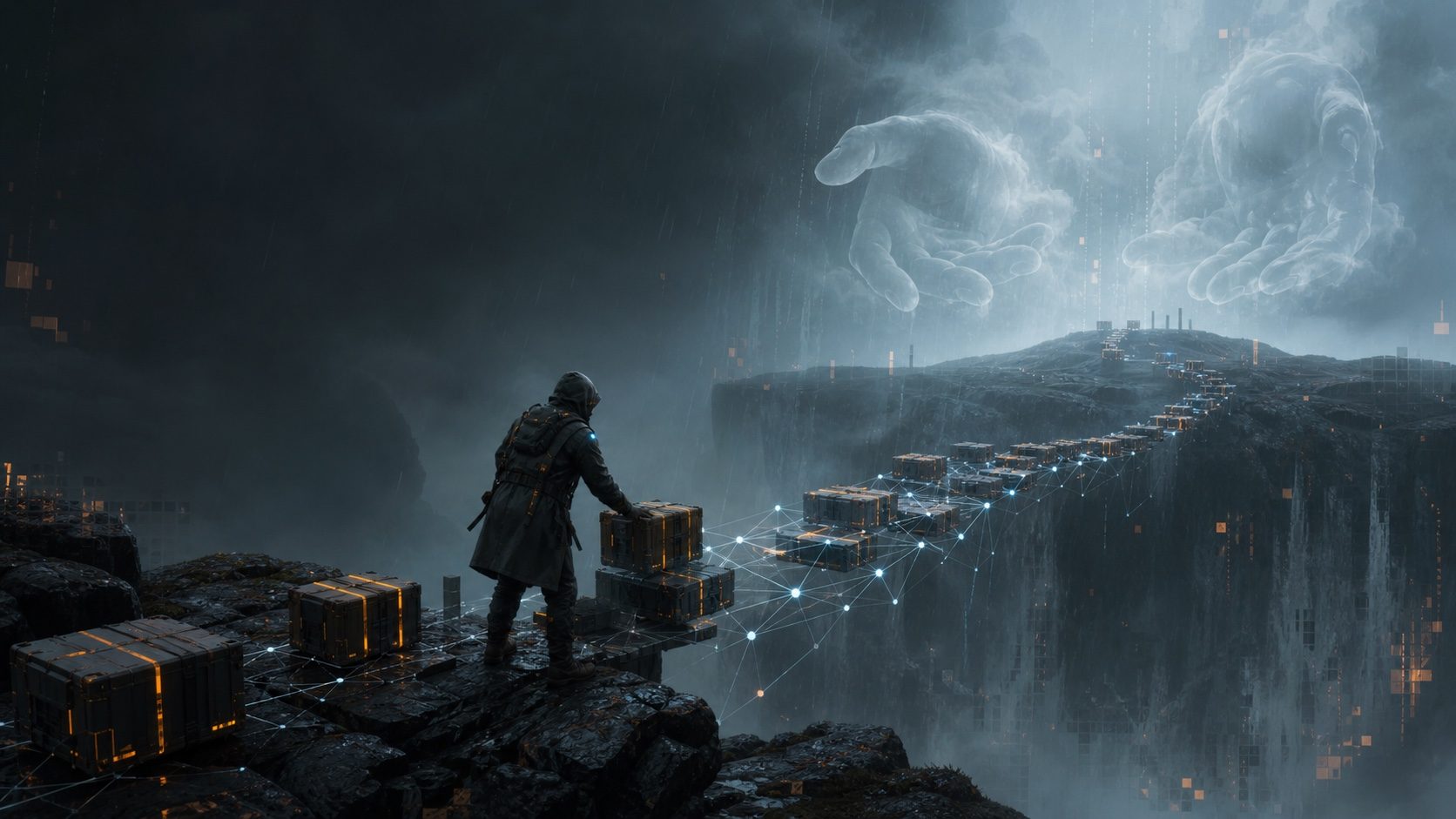
Death Stranding goes far beyond the graphics and the unusual gameplay. In my reading, it's almost a digital therapy session. Kojima seems to have dived so deep into the psyche that what he delivers isn't a delivery game: it's a treatise on connection, trauma and fatherhood, on how, even in a ruined world, it's still possible to rebuild bonds.
A world in collapse, or a mind in collapse
The cities are isolated, everyone lives in bunkers, the rain ages whatever it touches, and spectral creatures prowl the landscape. But this world isn't only post-apocalypse: it's the portrait of a mind in collapse. In psychoanalysis, this recalls the psychotic structure, when the registers that hold reality together come untied for lack of what Lacan calls the Name-of-the-Father.
What the Name-of-the-Father is
The Name-of-the-Father isn't your biological father. It's a symbolic concept. Imagine the mind works like a camping tent: to stand up, it needs three guy lines tied together, the Real (the raw world, the sensations), the Symbolic (the words, the rules, what gives things their names) and the Imaginary (the images we make of ourselves and others). The Name-of-the-Father is the central knot that holds the three together: the thing that lets you make sense, organize desire and live in society. It appears when the child understands that it isn't everything to the mother, that there's a limit, a law that comes from outside. When that knot is missing, in psychosis, the lines come loose: reality floods in without mediation, fantasy mixes with the real, and the subject tries to invent a solution on his own, often a delusion. That's exactly the world of Death Stranding: monsters appearing out of nowhere, past and present blending, everything shot through with the real unfiltered.
Sam, the one who stitches the pieces
That's where Sam Porter Bridges comes in. The mission of delivering packages is just the shell. Really, Sam is the only one trying to re-stitch this world: each city he connects to the network is a step in reintegrating the human, a mending of symbolic bonds. And there's a lovely detail: you find structures left by other players, a ladder, a bridge, a shelter. You never see these people, but you feel they passed through, that they cared. Winnicott called this transitional space: the place where we create and share without needing to see the other (Playing and Reality, 1971). Death Stranding is a post-apocalyptic playground where each gesture of help is an act of resistance.
Sam and the BB: becoming a father in order to rebuild yourself
The part that gets to me most is the relationship between Sam and the BB, the baby he carries on his chest. At first the BB seems like a tool. Over time, Sam talks to it, cares for it, soothes it, and that becomes love. It's the concept of holding, also Winnicott's: it isn't just holding the baby physically, it's sustaining it emotionally, it's saying "I'm here, you're allowed to exist." Sam, a man full of trauma, comes to perform that function and becomes the very thing he never had. In doing so, he rebuilds himself. And there's Clifford, the tragic father, the representation of what Freud called the return of the repressed: what we push into the unconscious comes back distorted, painful, sometimes monstrous. Sam has to face the pain of the paternal absence in order, at last, to become a father.
Winning by helping
Most games set you against someone: win, climb the ranking. Death Stranding does the opposite, here you win by helping. You leave a bridge for a stranger, give a like for a shelter found in the storm, cooperate without knowing who's on the other side. To me that's deeply revolutionary: it's as if the game were saying you aren't alone, that you can be a point of connection. Death Stranding is a game, of course, but it's also a map of the soul. It's about carrying weight, stumbling, falling and going on. It's about becoming a bridge where there was only a gap.

Interested in Death Stranding? Grab it here and help the channel grow. 🎮
See Death Stranding Affiliate links. As an Amazon Associate, this site earns from qualifying purchases, at no extra cost to you.Related
Death Stranding 2: the grief that can't be worked through GTA doesn't sell crime, it sells desireReferences
Lacan, J., the concepts of the Name-of-the-Father and the registers Real, Symbolic and Imaginary. · Winnicott, D. W. Playing and Reality (1971), transitional space and holding. · Freud, S., the return of the repressed.
Comments
What did you think of this piece? Agree, disagree, have another reading of the game? Drop a comment below, I read them all and love keeping the conversation going. 👇