
Gears of War: the muscle is armor against pain
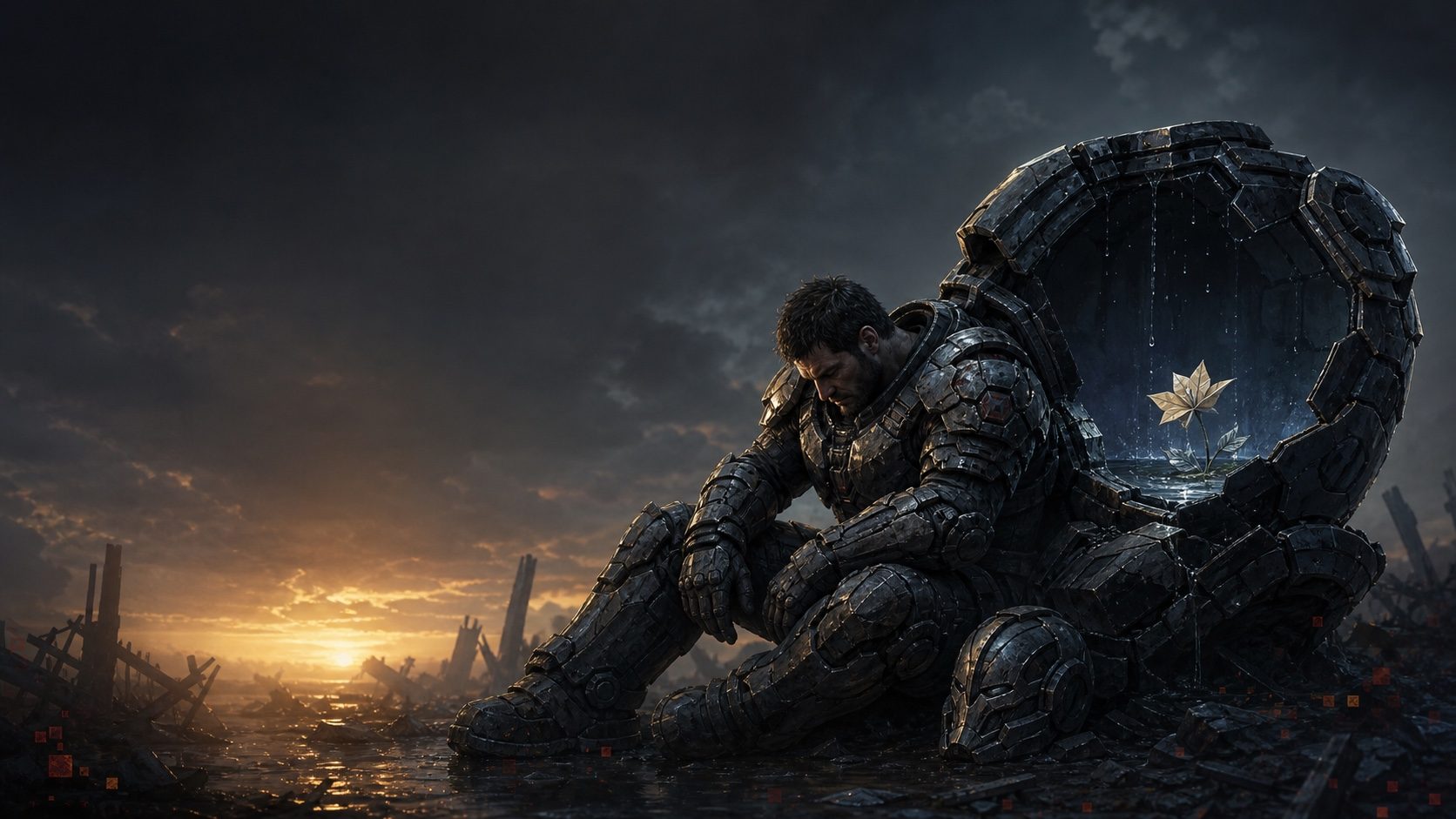
At first glance, Gears of War is the peak of macho excess: men the size of wardrobes, necks thicker than their thighs, a chainsaw bolted onto the rifle, everything gray and blood. It's easy to laugh and move on. But if you look beneath that absurd armor, you find something else, and it's the thing almost no one talks about: Gears is, deep down, a game about mourning.
The body as fortress
Look at the design. Everything in Gears is plating: the monstrous COG armor, the hypertrophied muscles, the constant bravado, the grunt where speech should be. It's masculinity turned into a shell. And a shell serves only one purpose, to let nothing in. Psychologically, all that armor protects against what the characters can't afford to feel: fear, sadness, fragility. In a world of permanent war, feeling is dangerous. So they harden the body to keep from softening inside.
The manic defense
Melanie Klein described a mechanism that explains Gears like few things can: the manic defense. It's when, faced with an unbearable loss, a person doesn't descend into mourning, instead does the opposite: gets agitated, triumphs, controls, attacks, keeps up a frantic activity so as not to feel the pain. Gears is that made playable. With every casualty, no one stops to cry; the answer is more violence, more attack, more advance. The noise and the fury exist precisely to cover the silence where sadness would live. It's the masculinity that only knows how to turn pain into rage, because rage looks like strength and sadness looks like weakness.
Dom and Maria: the crack in the armor
And then the game does something brave: it cracks its own armor. Dom spends the whole saga searching for Maria, his missing wife. When he finally finds her, she is unrecognizable, destroyed by torture, past any return. And Dom, the tough soldier, has to make the most devastating gesture of all, out of love. In that moment, the entire shell of Gears crumbles, and what's left is a man broken by pain. It's the scene that reveals the truth the game had been hiding behind the muscle: beneath all that plated strength, there was, the whole time, a grieving heart that was never allowed to cry.
The brotherhood only war permits
There's also the bond between Marcus and Dom, and among the whole squad. It's real, deep affection, but one that can only express itself in the language of war: covering each other, dying together, loyalty on the battlefield. It's the masculine bond that, culturally, many men only allow themselves to feel when it comes disguised as combat camaraderie. Gears shows, without meaning to, a social sorrow: that for many men the only place where love between them fits is the front, where it can be called "brotherhood" instead of love.
Why this matters
Gears of War is a whole lot of fun, and it doesn't have to stop being. But it's also, quietly, a portrait of the cost of a masculinity that can't feel. Armor protects, and imprisons. It keeps fear on the outside, but locks pain on the inside, with no way out. And when loss finally breaks through (and it always does, as with Dom), the damage is even greater because there was never any room to work it through. Beneath every chainsaw, there's a man who needed to cry and didn't know how.

Interested in Gears of War? Grab it here and help the channel grow. 🎮
Gears of War: Reloaded Gears 5 Gears of War 3 Affiliate links. As an Amazon Associate, this site earns from qualifying purchases, at no extra cost to you.Related
Red Dead Redemption 2: Arthur finds out he's going to die, and starts to live Kratos killed his own gods, and his own fatherReferences
Klein, M., the manic defense against the depressive position and mourning. · Freud, S., the work of mourning and its avoidance.
Comments
What did you think of this piece? Agree, disagree, have another reading of the game? Drop a comment below, I read them all and love keeping the conversation going. 👇