
Red Dead Redemption 2: Arthur finds out he's going to die, and starts to live
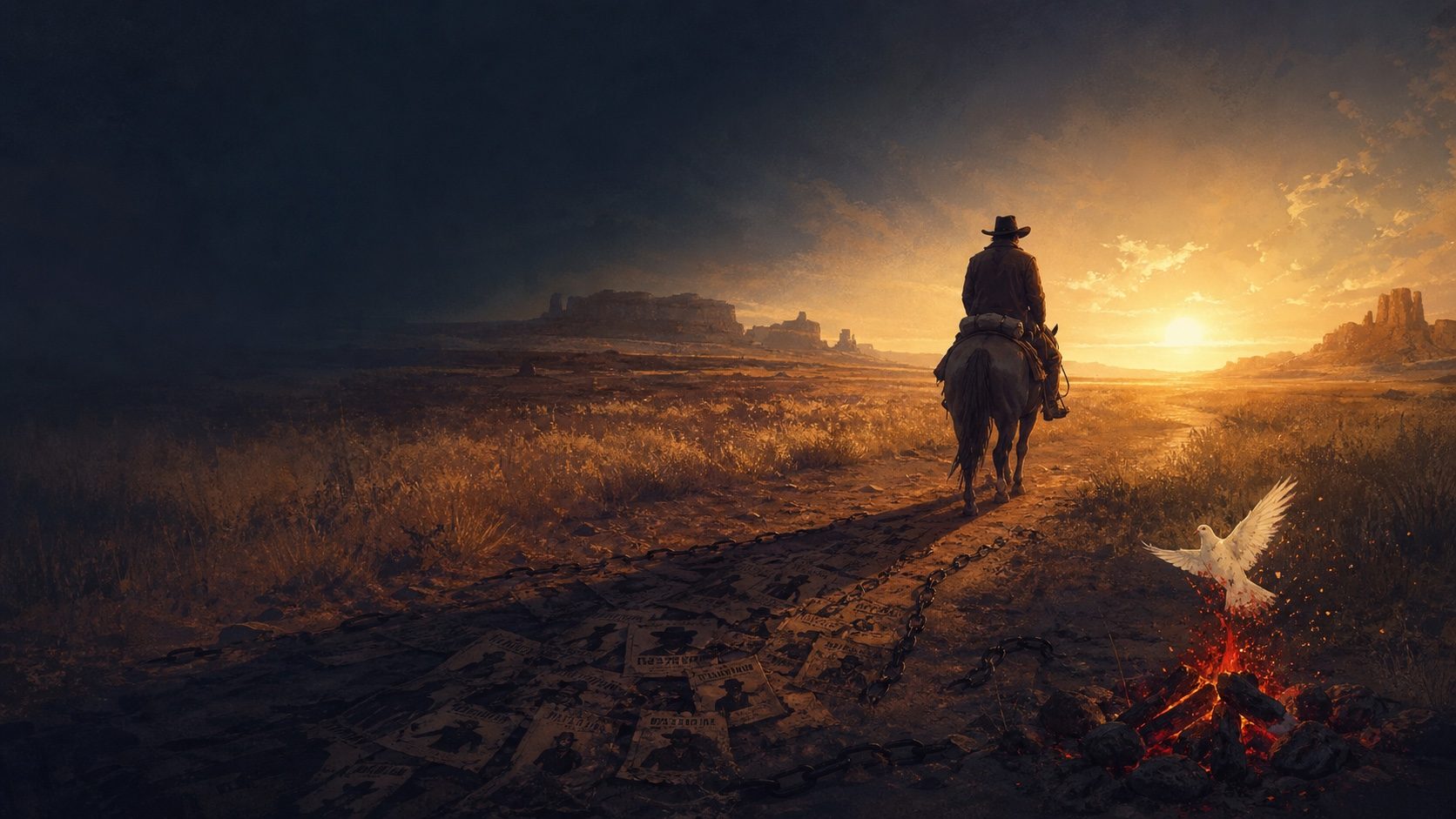
For dozens of hours, Red Dead Redemption 2 intoxicates you with the most delicious fantasy the Western has to offer: you are Arthur Morgan, the powerful outlaw who robs, shoots, rides and laughs at everything, master of his own fate in a world that seems to exist only to be conquered. Until, in the middle of some routine shakedown, Arthur coughs. And coughs blood. The doctor puts a name to it: tuberculosis. In that world, with no antibiotics, that is a death sentence, and the whole game changes temperature. Overnight, potency turns into helplessness, the party turns into mourning, and that cowboy who thought himself invincible discovers, right in front of the player, that his time is running out. It's one of the most brutal blows a video game has ever landed: it rips you out of that frenetic, fun rhythm and shoves you, without warning, into a tension of loss and helplessness that never lets go. And the most beautiful part is what comes next, because it is exactly when Arthur discovers he's going to die that he finally starts to live. RDR2 is not a Western about guns and horses. It's a study in psychic redemption.
Death as an alarm clock
While death stays a distant abstraction, we live on autopilot, and, in Arthur's case, that autopilot had an almost manic rhythm: the omnipotence of the outlaw who robs trains, settles everything with a bullet, drinks until he can't stand and turns even his own hangover into a joke (anyone who played remembers the classic drunken night at the bar, good for plenty of laughs). It's the grandiosity of someone who acts as if he were indestructible and never had to stop and think about the meaning of anything. The diagnosis bursts that bubble: it makes time finite, and finite time changes everything. Suddenly every choice weighs, because there aren't many left. It's no coincidence: in the clinic, it's common to see people, faced with a grave diagnosis, reorganize their entire lives, discover what matters, settle their accounts. Finitude isn't only loss, it gives value back to what remains. Arthur stops merely obeying and starts asking himself what kind of man he wants to have been.
Reparation: mending what you destroyed
From there, Arthur changes his behavior in a very specific way: he starts to give back, to care, to protect, to settle debts, including the emotional ones. Melanie Klein gave this impulse a name: reparation. It's the psychic movement of someone who recognizes the harm he caused and feels a genuine need to mend it, to restore what (and whom) he hurt. There's a scene that condenses this in a deeply moving way: Arthur's encounter with the nun, Sister Calderón, in which he, the tough guy who never lowered his guard, admits, almost awkwardly, that he's afraid. It's one of the moments of greatest dramatic depth in the game, and it's no accident that it comes precisely here: reparation isn't born of strength, it's born the instant Arthur allows himself, at last, to be afraid and to not know. It isn't paralyzing guilt; it's guilt that turns into reparative action. Arthur doesn't flagellate himself for what he did, he acts to leave things a little better than he found them. Every gesture of care near the end of the game is an act of reparation, an "I can't undo the past, but I can answer for it now".
Leaving the gang is leaving a tyrannical superego
The plot personifies all that omnipotence, grandiosity and, in the end, perversity in a single figure: Dutch, the gang's leader. At first, Dutch is almost an idealized father, keeper of a plan, a law, a dream of freedom. Little by little that law rots: it turns into manipulation, paranoia, the sacrifice of others in the name of his own vanity. Leaving the gang, for Arthur, is the psychic equivalent of freeing himself from a tyrannical superego. And here a parenthesis is worth it, because many people confuse the terms: the superego is not the "ego". The ego is the self that negotiates with reality, that manages daily life; the superego is the inner agency that judges, demands and punishes, the voice inherited from authority that dictates what you should be and measures how much you owe. A tyrannical superego is that voice when it becomes an executioner: it promises belonging in exchange for total obedience, and charges your soul as interest. Growing up, there, is being able to say "this ideal corrupted me" and choose your own values. Arthur trades blind loyalty to Dutch for loyalty to something inside himself that was still worth saving.
Dying a whole man
Arthur's ending is one of the best-written deaths in video games precisely because it isn't about winning, it's about working-through. He faces death having made peace with who he was and having chosen, in the little time he had, to be better. It's the opposite of despair. It's the same wholeness we discussed in the analysis of The Last of Us: a man who, at the decisive moment, acts from what is most human in him. Arthur doesn't die as the outlaw he began as. He dies as someone who, facing the end, found himself again.
I need to confess something personal here, because few games have ever moved me this much. With a gorgeous soundtrack stitching the moment together, I couldn't hold back: I cried, for real, before a farewell that took hold of me completely. And the strangest part was what came after, as good as the game's epilogue is, for me it was marked by an enormous emptiness. I confess I nearly stopped there; without Arthur Morgan, I almost didn't want to keep playing. If that isn't proof of the bond that good writing builds between player and character, I don't know what is.
Why it gives you chills
RDR2's redemption works because the game is honest: it erases nothing. Arthur did terrible things, and the game doesn't pretend otherwise. What changes isn't the facts, it's the meaning. To redeem yourself isn't to come out clean; it's to take ownership of your own story and answer for it with the life you have left. That's why Arthur's journey moves so many people who never went near a revolver: because, deep down, all of us will one day have to make peace with what we did and can't undo. RDR2 shows that it's possible, and that sometimes time has to run out for us to finally begin.

Interested in Red Dead Redemption 2? Grab it here and help the channel grow. 🎮
Red Dead Redemption 2 Red Dead Redemption Affiliate links. As an Amazon Associate, this site earns from qualifying purchases, at no extra cost to you.Related
Kratos killed his own gods, and his own father The Last of Us Part II: why the story falls apartReferences
Klein, M., the concept of reparation and the depressive position. · Freud, S., working-through in the face of loss and finitude.
Comments
What did you think of this piece? Agree, disagree, have another reading of the game? Drop a comment below, I read them all and love keeping the conversation going. 👇