
A Plague Tale: the dead mother and the marked child
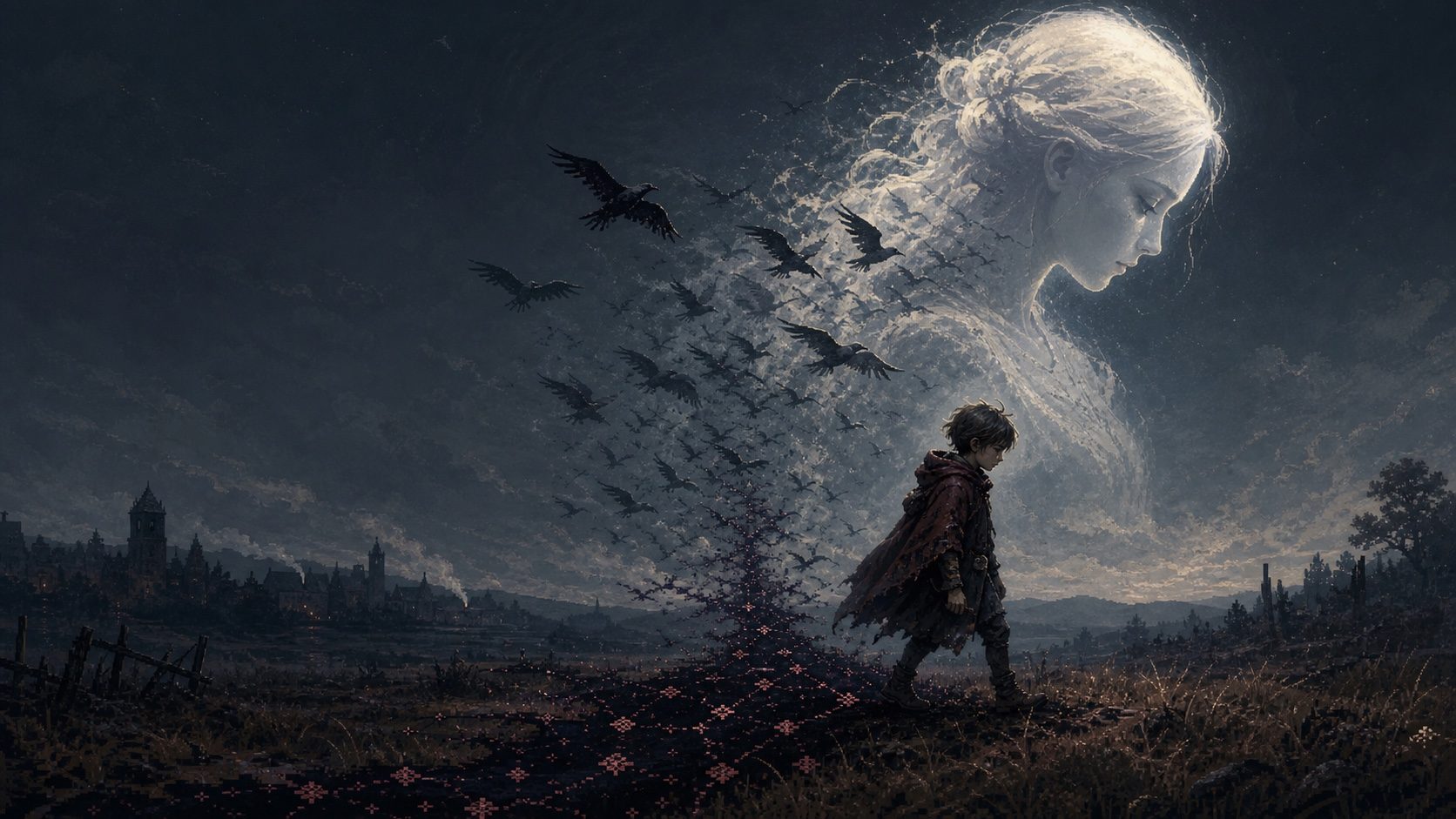
In the middle of the Black Death, between tides of rats and the fires of the Inquisition, A Plague Tale places in your hand the most fragile thing there is: a child's hand holding another's. Amicia carries her little brother Hugo through the end of the world. But what makes the game so psychoanalytically overwhelming isn't the outer horror, it's the family these two children come from. Because, before the rats, what fell ill there was a bond: a mother, a marked child, and a fantasy every parent knows deep down, even without admitting it.
The dead mother
Béatrice, the mother, is alive, and, even so, absent. An alchemist, she lives absorbed in a single mission: curing Hugo's illness. She spends her days shut away in the laboratory, and Amicia grows up beside a mother who is present and, at the same time, completely out of reach. André Green gave this experience a name: the complex of the dead mother (La mère morte, 1980). It isn't about a mother who died, it's about a mother physically alive but psychically dead in her child's eyes, emptied of affect by a depression or an obsession that consumes her from within. For the child, it's as though the source of warmth had become a distant, toneless, almost lifeless figure. Green describes the result: a "clinic of emptiness," a chronic feeling of not existing for the other. It's exactly Amicia's emotional ground, a girl who has to wrest from her mother an attention that is always somewhere else.
The marked child
And where is all the mother's attention? On the other child. Hugo carries the Macula, a condition in his blood that binds him to the rats and the plague, a danger he has borne inside himself since birth. He is, in the most literal sense, the marked child: the one on whom all the family's dread falls, the bearer of something that frightens everyone. And there's a devastating detail the game reveals: the Macula is an inheritance from the maternal line. That is, the "danger" that inhabits Hugo came from his own mother's body, was transmitted by her. The son's illness is also a dark piece of the mother that returned in him.
The fantasy of the "spoiled" child
And here A Plague Tale touches on something psychoanalysis knows well and almost no one says out loud. Every pregnancy carries, alongside the dream of the ideal baby, the one Freud called "His Majesty the Baby", a shadow: the unconscious fear of bearing a "spoiled," damaged, monstrous, bad child. It's an ancient, universal fantasy, the reverse side of desire. Melanie Klein described how the child, very early, populates the interior of the mother's body with good and bad objects, and how the baby itself can be fantasized, by the mother, as the bearer of something good or something destructive. Hugo is that fantasy made flesh: the child who really does carry "the bad" inside him, the dangerous thing, the plague. And the most poignant part is that this bad thing came from the mother. The fantasy of "I don't want to bear a spoiled child" finds, in Béatrice, its cruelest realization, she bore, and transmitted, precisely what every mother fears to transmit.
That's why Béatrice's love for Hugo has that anguished, almost suffocating intensity: she loves and fears her own child at the same time, she devotes herself to the cure like someone trying to repair a guilt that is hers. And that's why Amicia is left over, because the mother is entirely taken up with fixing the marked child, with no psychic energy left for the "healthy" daughter.
Amicia: the child who had to become a mother
Faced with a dead mother and a marked brother, Amicia does what many children do in that place: she takes the vacant post. She becomes the caretaker, the protector, Hugo's functional mother. The clinic calls this parentification, the child pushed too soon into an adult's emotional responsibilities. Winnicott would describe the cost: to cope, Amicia builds a false self, a shell of competence and control, while the real girl, entitled to be afraid and to play, stays buried. But the game also shows the beauty of that gesture: the way Amicia soothes Hugo in the dark, names what he feels, and holds up his courage is exactly what Winnicott called holding, emotionally holding the other, saying "I'm here, you're allowed to exist." Amicia becomes, for Hugo, the good-enough mother that Béatrice, trapped in her own guilt, couldn't be.
And there's something even finer here, which Wilfred Bion named: when Amicia gives Hugo's terror in the dark a name, she isn't only holding him, she's performing the alpha function. Bion described the maternal mind in reverie as the one that receives the child's raw dread, metabolizes that terror, and returns it in a thinkable, bearable form. It's that function which Béatrice, emptied out, doesn't perform, and which the sister, still a child herself, takes on in her place: Amicia thinks, for Hugo, what he alone could not think.
The rats, the tide of the Real
And there are the rats, millions of them, a living tide that devours everything the light doesn't protect. They are the plague, but psychoanalytically they are something more: the death drive in its raw state, the uncontrollable, that which no human order can dam. It's no accident the tide answers to Hugo, to what he carries. It's the inner bad thing overflowing into the world, the family's anguish becoming collective catastrophe. Each torch Amicia lights is a minimal gesture of life against a hungry darkness.
The impossible mourning: to love is, sometimes, to let go
It's in Requiem that the wound opens all the way. The Macula grows, and with it Amicia's desperation to save Hugo, at any cost. And here happens what we already saw in Death Stranding 2 and Hellblade: the refusal to accept a loss can be more destructive than the loss itself. The more Amicia clings to the impossible cure, the more violence she sows. Love, when it turns into an absolute refusal to lose, stops protecting and starts to devastate. The ending is one of the most painful things games have ever dared: for the plague to stop and the world to survive, Hugo has to go, and it's Amicia who must let him go. There is no magic cure. There is the hardest lesson of all: the highest form of love, sometimes, isn't to hold on with all your strength, it's to have the courage to let go. It's the work of mourning in its rawest version.
Why it stays with us
A Plague Tale strikes deep even in someone who has never seen a rat up close because it speaks of what is most intimate in a family: the mother who can't be present, the child on whom everyone's fear falls, the child who grows up too soon to carry the weight, and the day life demands the acceptance of a loss you'd do anything to avoid. Beneath the medieval setting, it's a story about what we inherit from our parents, including what they feared to pass on to us, and about the courage to love even what came marked.

Interested in A Plague Tale? Grab it here and help the channel grow. 🎮
A Plague Tale Collection Requiem Innocence Affiliate links. As an Amazon Associate, this site earns from qualifying purchases, at no extra cost to you.Related
Hellblade: what psychosis looks like from the inside Death Stranding: a world without the Name-of-the-FatherReferences
Green, A. The Dead Mother (La mère morte, 1980), in Life Narcissism, Death Narcissism. · Klein, M., the fantasies about the interior of the maternal body and the good/bad object. · Winnicott, D. W., holding and the false self. · Bion, W. R., alpha function and reverie. · Freud, S., the work of mourning and the death drive.
Comments
What did you think of this piece? Agree, disagree, have another reading of the game? Drop a comment below, I read them all and love keeping the conversation going. 👇