
The avatar and the mirror: why we get attached to the character
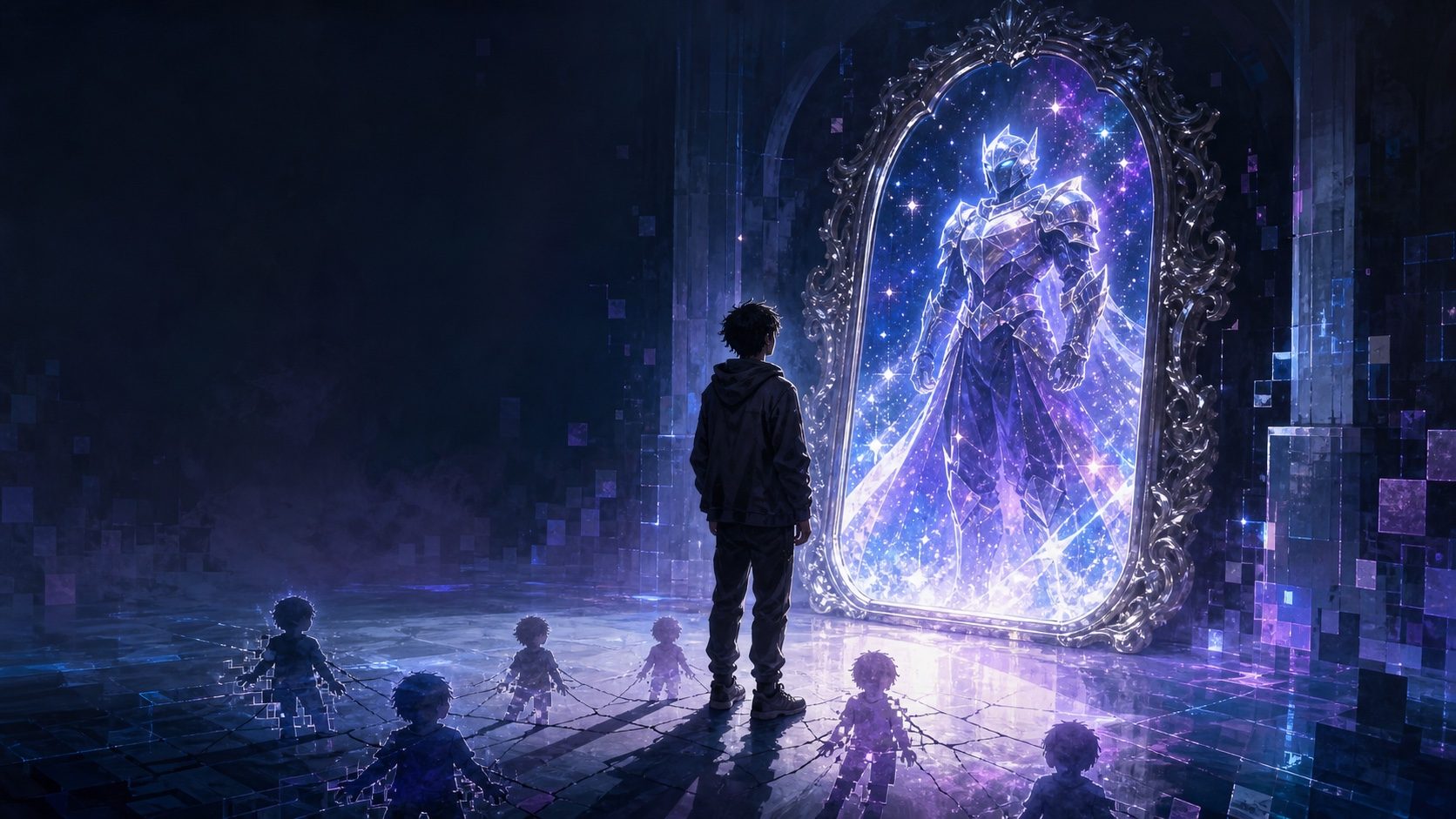
Have you ever felt a pang when your character dies? Or a rush of pride when they land the perfect hit? Strange, isn't it, they're made of pixels, and you know that. And yet, for a few hours, they are you. This fusion between the player and the figure on screen isn't silliness or immaturity. It touches one of the most founding moments of our psychic life, one Lacan described in a text from 1949: the mirror stage.
The first time we see ourselves whole
Lacan started from a simple scene: the infant, still without control of its own body, sees itself in the mirror and recognizes there a whole image, coordinated, complete. Except there's a mismatch: on the inside, the baby still feels fragmented, clumsy, dependent. The image in the mirror is more organized than the baby actually is. And the baby falls in love with it, takes that whole form on as "me." That, according to Lacan, is how the ego begins to form: out of an external, idealized image that promises a wholeness we don't yet have.
The avatar is a mirror that obeys
Now think about your character. They're nimble where you're clumsy, brave where you hesitate, competent in a way life rarely allows. You see them whole on the screen and, better still, they respond to your command. The avatar is a version of the mirror stage pushed into the interactive: an ideal image of yourself in which you recognize yourself, only this time the image moves when you want it to. No wonder it hurts when it falls. For an instant, it's your own ideal image collapsing.
Why we choose the way we choose
This helps explain that sometimes-lengthy hour of creating the character. The choices of face, body, class and name aren't only aesthetic: you're composing an image to inhabit, an "I" to try on. Some people build an avatar that looks like them, a literal mirror. And some build the opposite of who they are, the shy one who becomes the brutal warrior, the person who feels voiceless who becomes the charismatic leader. In both cases, the game offers what Lacan's mirror offered: a whole form in which to deposit what we'd like to be.
The pleasure and the trap
There's something deeply pleasurable and even healthy in this. Rehearsing identities, trying out being brave, competent, someone else, the game is a safe space for that, almost a laboratory of the self. The thing to watch is when the ideal image on screen becomes too good compared with life: when the competent avatar serves to avoid facing one's own sense of incompleteness, and the fusion turns into escape. Lacan warned that this identification with the ideal image has an alienating side, we bind ourselves to a form that is, deep down, more promise than truth.
A mirror to play at being
In the end, attachment to the avatar isn't weakness, it's one of the most human things there is, repeating in the form of a game a gesture that founded our very own self. Next time you feel that slightly silly pride in your character, or that pang when they die, smile: it's the mirror stage at work, the same mechanism that, long before any joystick, taught you to say "this one right here is me."
Enjoy this kind of read, psychoanalysis mixed with games? Over on my Mercado Livre profile I leave picks of games worth analyzing. 😉
My picks (Mercado Livre) Affiliate links (Mercado Livre). This site may earn a commission on qualifying purchases, at no extra cost to you.Related
The Plucky Squire: what if your life were written by someone else? Streamers and the ego-ideal: who are you when the camera turns onReferences
Lacan, J., The Mirror Stage as Formative of the Function of the I (1949; published in the Écrits). · The concept of the ego-ideal and the specular image in Lacanian theory.
Comments
What did you think of this piece? Agree, disagree, have another reading of the game? Drop a comment below, I read them all and love keeping the conversation going. 👇