Why we like to feel afraid in horror games
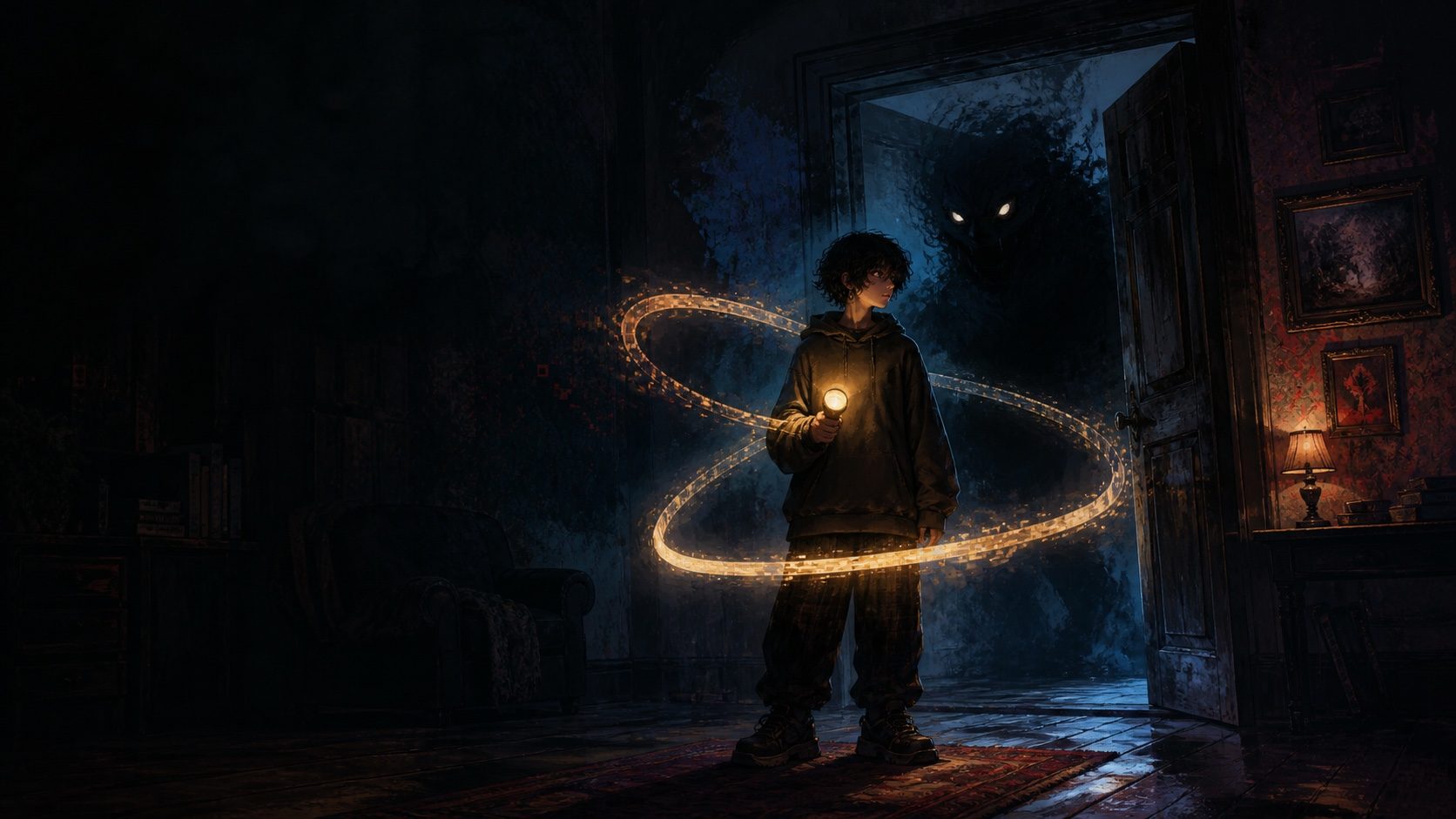
There's something seemingly absurd about the genre: we pay, we sit in the dark, and we choose to feel awful on purpose. Racing heart, sweaty palms, that chill of knowing something horrible is about to leap out. And when it's over, all we want is to play again. Why would a creature as averse to danger as the human being go looking for fear for fun? Psychoanalysis has a beautiful answer, and it starts with a child and a wooden spool.
Freud's spool: mastering what scares us
In 1920, Freud described a scene he observed in a small grandson. The boy, whenever his mother left, would get distressed. To cope with it, he invented a game: he threw a spool away, saying something like "gone" (fort), and pulled it back, saying "here" (da). Freud understood the gesture: the child was actively staging the anxiety he suffered passively. Instead of merely enduring his mother's disappearance, he was now commanding the disappearance and the return. Repeating the bad experience, but in control, is a way for the mind to tame what terrifies it. Freud called this, more broadly, the compulsion to repeat.
The horror game is a giant Fort-Da
Now swap the spool for the controller. In a horror game, you stage the fear on purpose, except this time you're the one pressing the buttons, the one deciding to walk into the dark room, the one advancing down the corridor. The anxiety that in real life arrives without warning is here something you summon. That changes everything: the scare is still real in the body, but you're in command of the situation producing it. It's Fort-Da on an epic scale, turning helplessness into control, living the dread while knowing that, deep down, your hand is on the wheel.
The relief that comes after the scare
Notice what happens when the danger passes: an almost euphoric relief, a nervous laugh, the urge to keep going. Horror works through cycles of tension and discharge. With each scare survived, the body dumps the adrenaline it had stored up and the mind logs a small victory: "I held on." It's safe emotional training, you test the limit of your fear inside a frame that guarantees nothing real will happen to you. You leave a horror game not destroyed but, curiously, strengthened, like someone who has proven to themselves that they can take it.
Facing the monster to face yourself
There's a deeper layer still. Horror tends to seize precisely what we'd rather not look at, death, the rotting body, guilt, madness, and turns it into a visible, confrontable monster. Giving shape to the unnameable is, paradoxically, a way of mastering it: a fear with a face and rules is less terrifying than a diffuse, nameless anxiety. The horror game lends contour to our deepest fears and lets us walk through them with the controller in hand. That's why the genre, far from being mere digital sadism, can be profoundly therapeutic.
Feeling fear, in control, is rehearsing courage
So whoever likes horror isn't a masochist or a weirdo, they're doing, as an adult in the dark of the room, the same thing that boy did with the spool: taking anxiety by the hand and saying "now I'm the one in charge." Every corridor faced is a small rehearsal of courage. And maybe that's the genre's secret promise: that you can look at what scares you head-on and, when the credits roll, still come out whole.
Into this kind of read, psychoanalysis mixed with games? On my Mercado Livre profile I keep a list of games worth the analysis. 😉
My picks (Mercado Livre) Affiliate links (Mercado Livre). This site may earn a commission on qualifying purchases, at no extra cost to you.Related
Why the monster that stares back scares you more Silent Hill 2: guilt and the return of the repressedReferences
Freud, S., Beyond the Pleasure Principle (1920): the Fort-Da game and the compulsion to repeat.
Comments
What did you think of this piece? Agree, disagree, have another reading of the game? Drop a comment below, I read them all and love keeping the conversation going. 👇